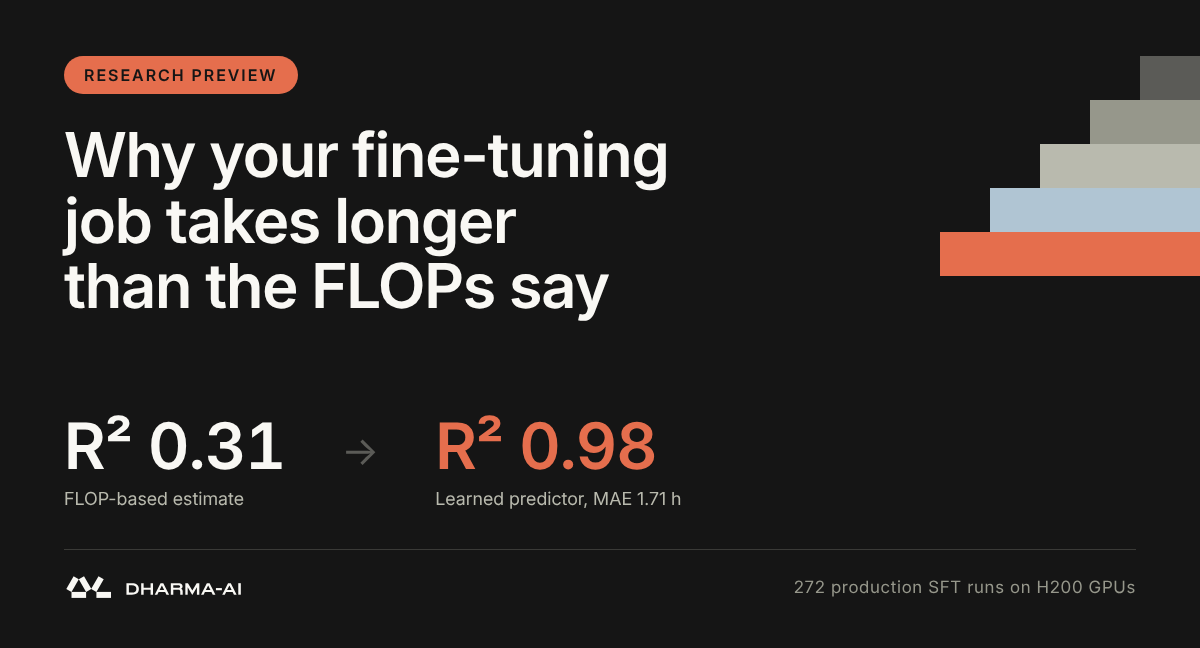
A preview from the Dharma-AI team argues that the standard FLOP-based estimate is a poor predictor of how long fine-tuning jobs take on shared GPU clusters. The team studied 272 supervised fine-tuning jobs run on NVIDIA H200 GPUs, totaling about 7,382 GPU-hours.
The FLOP estimate, which divides 6·P·D by GPU throughput at a given utilization rate, explained little of the observed runtime. The authors report R² = 0.31 and a mean absolute error of 12.41 hours. They say the estimate is sensitive to the assumed Model FLOPs Utilization (MFU), and that even the best setting they tested, 30%, left a mean error above 12 hours on jobs averaging 23 hours.
The team also compared a more detailed analytical model, Calculon, which they extended to cover LoRA, grouped-query attention, fused attention, bfloat16 and SwiGLU. According to the preview, its estimates matched a median of only 11% of observed wall-clock time.
The authors then trained learned regression models that use only information available before a job is dispatched. Linear Regression, Ridge, XGBoost and CatBoost were compared. Rid