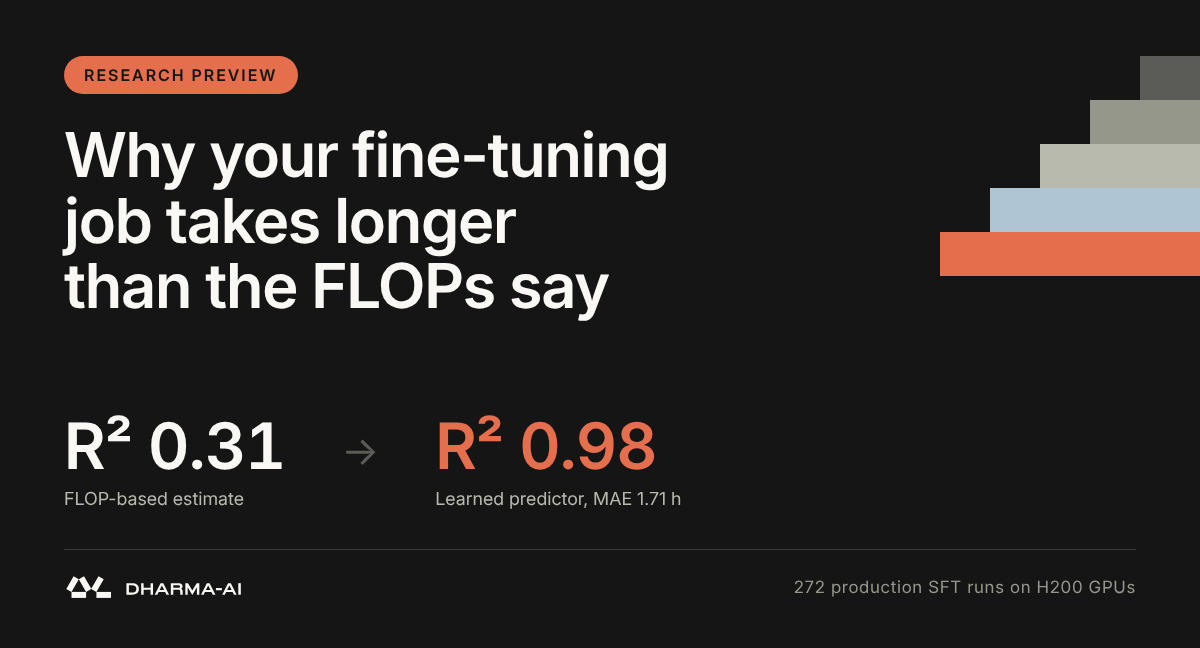
The most common way to estimate how long a fine-tuning job will take is a back-of-the-envelope FLOP calculation: count the training tokens, divide by what the GPUs can deliver, and assume a plausible utilization. The report under discussion tests that habit against 272 real supervised fine-tuning jobs on NVIDIA H200 GPUs, about 7,382 GPU-hours in total, and the result should make any cluster operator uncomfortable. The FLOP-based estimate explains little of the observed variation, with R² of 0.31 and a mean absolute error of 12.41 hours on jobs that average 23.43 hours.
The authors' explanation is persuasive. A job is more than its optimization loop. Environment setup, model download, tokenization, periodic evaluation, checkpoint uploads and final storage writes all happen around the training steps, and on a shared cluster they compete for network and storage I/O. Even the more detailed Calculon model, which the authors extended to cover LoRA and other features, matched a median of only 11% of observed wall-clock time. That is less a verdict on Calculon, which was built for step-level analysis, than a reminder of how much production time falls outside the step.
The more useful finding is what a learned predictor picks up. The CatBoost model, using only information available before dispatch, reaches a median absolute error of 0.51 hours in cross-validation, and its largest feature is the total number of evaluation samples over the life of the job. Evaluation volume, trainable parameter count and checkpoint settings matter as much as model size. Those are choices people often make out of habit when writing a training config, and they are exactly what a scheduler should be able to see.
The report is careful about its limits, and those limits should shape how anyone acts on it. Feature importance is not causation, the reported gains rest on one cluster and one GPU type, and there are only 13 runs above 60 hours, so the long tail is poorly characterized. Still, the operational case is clear. A scheduler that plans around a duration estimate with a median error near half an hour beats one planning around a nine-hour guess that finishes the next afternoon. Teams running shared clusters should log execution data now and begin testing learned predictors against their own FLOP estimates, rather than assuming the spec-sheet math is good enough.