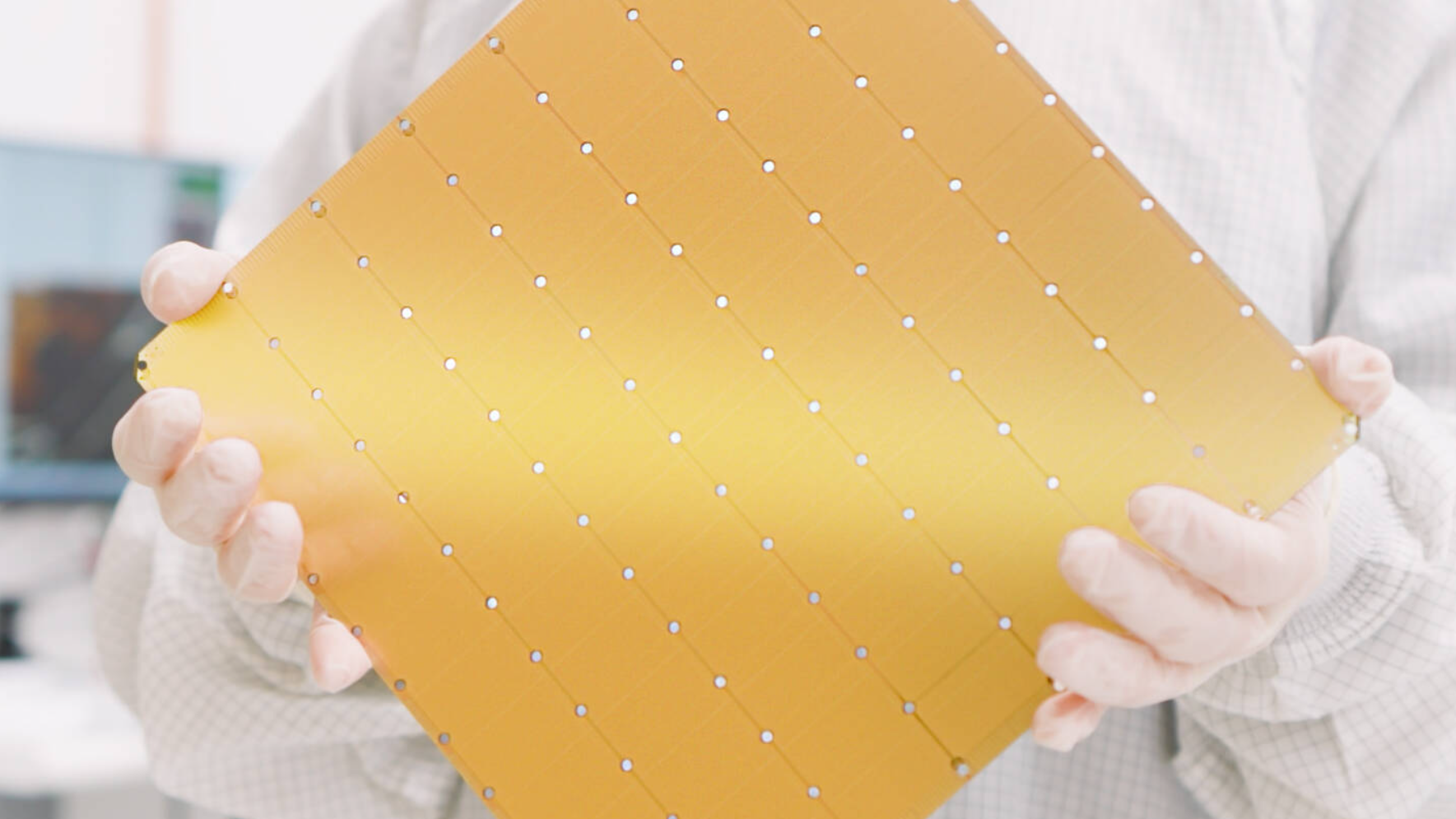
Cerebras has unveiled its CS-4 AI accelerator, a system the company's CEO Andrew Feldman claims represents the fastest hardware in the industry. The CS-4 achieves double the performance of its predecessor while maintaining the same physical chip footprint, a significant engineering accomplishment in an era where AI performance gains increasingly rely on architectural innovation rather than die size expansion.
The CS-4 builds on Cerebras' distinctive approach to AI acceleration. The company designs massive wafer-scale processors that consolidate traditionally distributed compute onto a single chip. This architecture eliminates the interconnect bottlenecks that plague systems relying on multiple smaller GPUs or TPUs networked together. By concentrating more transistors on the chip and optimizing their arrangement, Cerebras extracted performance gains without increasing physical dimensions.
The doubling of performance on the same substrate reflects targeted improvements across multiple system components. Enhanced memory bandwidth, optimized instruction execution pipelines, and refined thermal management all contributed to the uplift. Cerebras likely improved clock speeds or instruction throughput per cycle without substantially increasing power consumption, a balance that remains difficult at the leading edge of semiconductor design.
This announcement comes as the AI accelerator market grows increasingly competitive. Nvidia dominates with its H100 and newer Blackwell GPUs, but alternatives are emerging. Amazon developed Trainium and Inferentia chips. Google expanded its TPU offerings. Intel entered with Gaudi. Against this backdrop, Cerebras positions the CS-4 as purpose-built for large language models and transformer-based workloads, where its memory bandwidth advantages become apparent.
The same-chip constraint carries real implications. Cerebras cannot simply add more silicon to chase performance gains. Instead, the company must optimize at the microarchitectural level: improving cache hierarchies, reducing latency in critical paths, and maximizing instruction-level parallelism. This forces engineering discipline that trickles down into production reliability and power efficiency.
Cerebras has pivoted toward system-level thinking rather than pure chip density. The CS-4 likely bundles improved cooling solutions, power delivery, and software stack refinements alongside hardware changes. The company's full-stack approach contrasts with GPU vendors who sell discrete accelerators that customers must integrate into larger systems.
Performance claims in AI hardware require scrutiny. Feldman's assertion of industry leadership depends on the benchmark, the workload, and the specific metric. Throughput gains on transformer inference might not translate across all use cases. Power efficiency ratios matter as much as raw speed for data center economics. Real-world model training on actual customer workloads provides the truest validation, not synthetic benchmarks.
The CS-4 enters a market increasingly concerned with cost-per-inference and training efficiency. Large enterprises running inference at scale care deeply about operational expense. A 2x performance jump on the same chip could reduce overall system costs if software optimization keeps pace and the hardware delivers those gains in production.
Cerebras must demonstrate sustained customer adoption for this announcement to carry strategic weight. Early deployments of prior Cerebras systems showed promise in specific domains, but broader enterprise adoption remains limited compared to established GPU suppliers with vast software ecosystems and proven deployment frameworks. The CS-4's technical merits mean little without clear paths to integration within existing machine learning infrastructure.