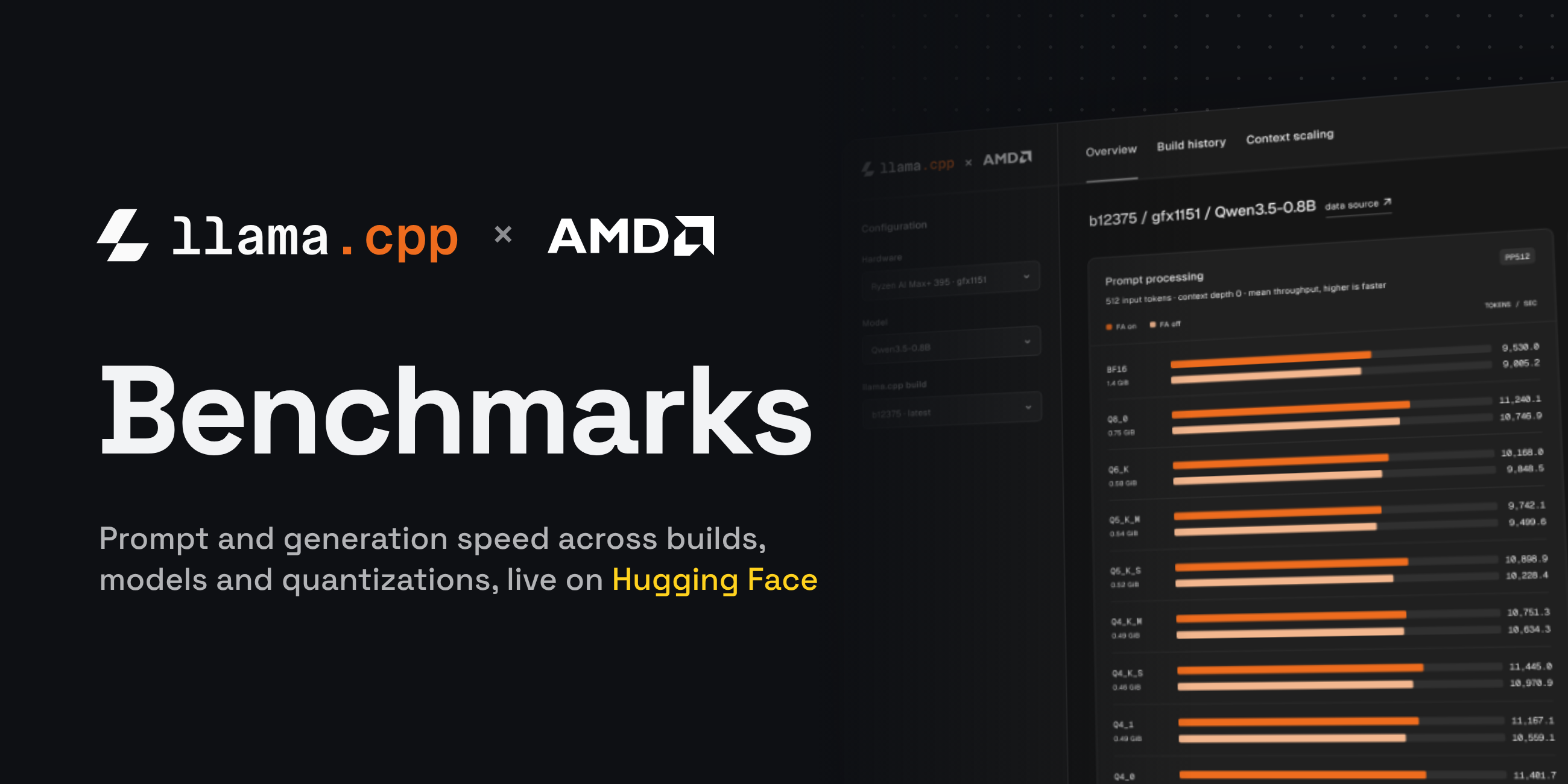
A new llama.cpp benchmark dashboard for AMD Ryzen and Radeon hardware is now on Hugging Face, and its most important feature is not the charts. It is the decision to make the benchmark workflow and underlying results public. Anyone who runs local inference knows how quickly performance shifts as models, kernels, and builds change. Without a visible record, claims about speed tend to rest on memory and anecdote.
The dashboard lets users choose hardware, a model, and a llama.cpp build, then compare quantizations and follow performance over time. The current hardware choices are Radeon 8060S (gfx1151) and Radeon AI Pro R9700S (gfx1201). The two reference tests, PP512 for prompt processing and TG128 for text generation, both start at context depth zero and report mean throughput in tokens per second. Those are useful baselines, but they are only a starting point. The Context scaling tab, which shows how token generation changes as context grows, is where many real workloads will live, and it deserves close attention from developers.
The methodology is also worth scrutiny. The project benchmarks prebuilt binaries distributed through llama-install.sh, runs the public gfx1151 and gfx1201 workflows weekly, tests with Flash Attention on and off, and uses 10 repetitions per configuration. Those choices make the numbers more trustworthy than a single run, and they make comparisons across weeks more meaningful. Readers should still remember that a plotted average is a summary, and that the chart's usefulness depends on the same conditions being held constant.
The dashboard reads directly from a public storage bucket, and each chart links to the folder containing the underlying data. That openness matters. A developer who sees a surprising result can open the raw files, reproduce a local run, or build an alternative chart. In a field where marketing numbers often arrive without methods, this kind of traceability should become the norm rather than the exception.
The next step is clear. The maintainers should keep expanding the model set and workload coverage, and they should say plainly which combinations are not yet tested. AMD users who depend on local inference should use the dashboard, inspect the data, and report gaps. Public benchmarks are only as good as the scrutiny they receive.