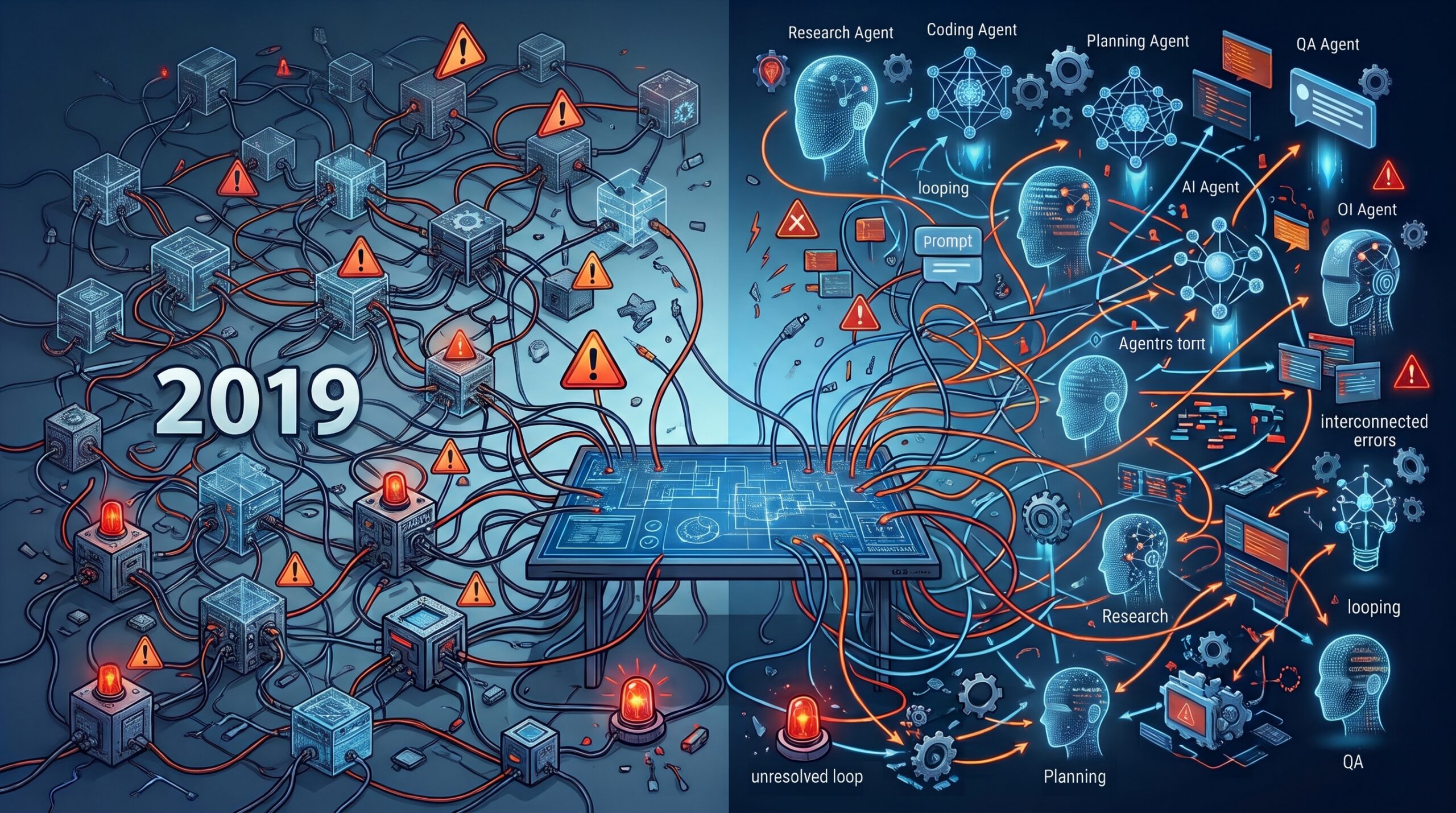
Multi-agent AI systems are repeating a problem that microservices created around 2019, according to an opinion piece on O'Reilly Radar. The author, who says they were on the design doc for a three-agent workflow, argues that splitting a workflow across agents can make the overall system harder to observe even when each agent works as designed.
The author describes an incident in which a summarizer agent dropped a field it judged to be low signal. A downstream recommender agent then made a confident recommendation without that field. Latency, error rates, and service responses all looked normal. A reviewer noticed the output quality had slowly declined, and tracing the cause took about three weeks.
The article says agents make these systems cheaper and faster to create, so product teams may build them without central tracking. It cites Cemri and coauthors, who annotated more than 1,600 execution traces across seven multi-agent frameworks and identified 14 recurring failure modes in a NeurIPS 2025 paper called MAST. According to the article, most failures trace back to how systems were specified and how agents coordinated, not to the underlying models.
The author recommends several practices carried over from microservices. These include an agent registry listing each agent's owner, scope, and permitted tool calls; distributed tracing using Op