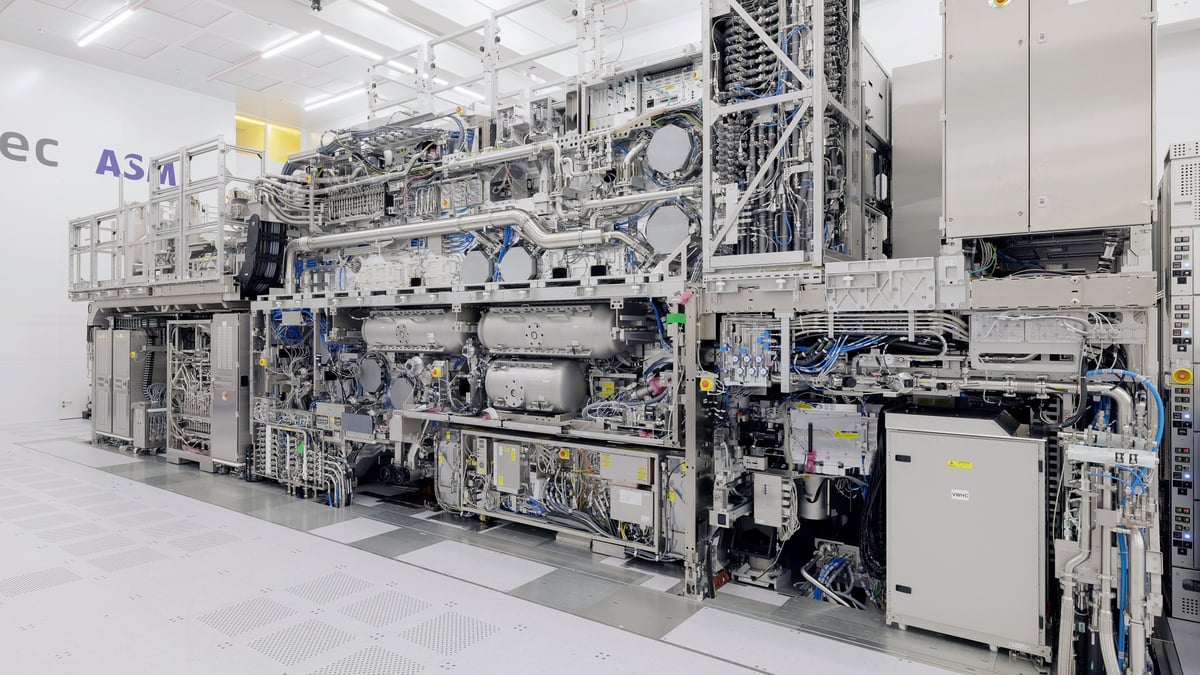
ASML has secured commitments from the three largest semiconductor manufacturers to adopt high-NA EUV photomasks, a move that consolidates its dominance in extreme ultraviolet lithography while China races to develop alternatives before the technology locks in globally.
The Dutch chipmaking equipment manufacturer convinced Taiwan Semiconductor Manufacturing Company (TSMC), Samsung, and Intel to transition to larger photomasks for its newest extreme ultraviolet (EUV) machines. The shift promises to increase throughput by 40 percent, making ASML's most advanced systems substantially more productive. This upgrade path creates a commercial lock-in effect. Once these three manufacturers retool their fabrication plants around the new mask standard, switching becomes prohibitively expensive, effectively cementing ASML's control over the most advanced semiconductor production capacity for years.
ASML's grip on EUV lithography remains uncontested globally. The company produces virtually every extreme ultraviolet machine used in high-volume chip manufacturing. The technology enables production of chips at the 3-nanometer node and below. Without EUV, manufacturers cannot produce the world's fastest processors, advanced artificial intelligence accelerators, or leading-edge memory chips.
The photomask upgrade represents an evolution of high-NA (numerical aperture) EUV systems that ASML introduced commercially. High-NA machines deliver better resolution and smaller feature sizes than previous-generation tools. By moving to larger photomasks, ASML provides its customers higher wafer throughput without sacrificing the resolution gains that justify the multi-billion-dollar equipment investment.
TSMC, Samsung, and Intel collectively control roughly 80 percent of the world's advanced semiconductor manufacturing capacity. Their unified adoption of the new photomask standard creates a self-reinforcing ecosystem. Photomask suppliers must invest in new infrastructure to produce larger masks. Design tools vendors must update their workflow software. The entire supply chain orients toward ASML's specification. This makes alternative approaches vastly more expensive.
China's semiconductor industry faces the steepest challenge. U.S. export controls and Dutch government restrictions prevent ASML from selling its most advanced EUV machines to Chinese manufacturers. Huawei, China's leading technology company, has mobilized a counter-strategy to break this dependence. The company is backing Yuliangsheng, a Chinese equipment maker attempting to develop indigenous EUV lithography technology. Huawei simultaneously develops relationships with alternative suppliers and invests in older EUV models it can legally acquire.
Yuliangsheng faces an engineering mountain. ASML spent decades building EUV capability, accumulating thousands of patents and refining production processes through billions in R&D spending. The Chinese effort requires matching this expertise while operating under economic sanctions. Even if Yuliangsheng produces functional EUV machines, they would likely lack the performance and throughput of ASML's latest systems.
The photomask transition underscores a deeper geopolitical reality in semiconductors. Control over manufacturing equipment determines control over chip production capacity. ASML's ability to set technology standards means it influences which countries can manufacture advanced chips and which cannot. The Netherlands, through ASML, effectively controls a critical chokepoint in global technology supply chains.
China's response reflects the stakes. Developing independent lithography capability ranks as a national technology priority. Success would reduce vulnerability to export controls. Failure perpetuates dependence on Western suppliers and creates leverage for Western governments in technology disputes.