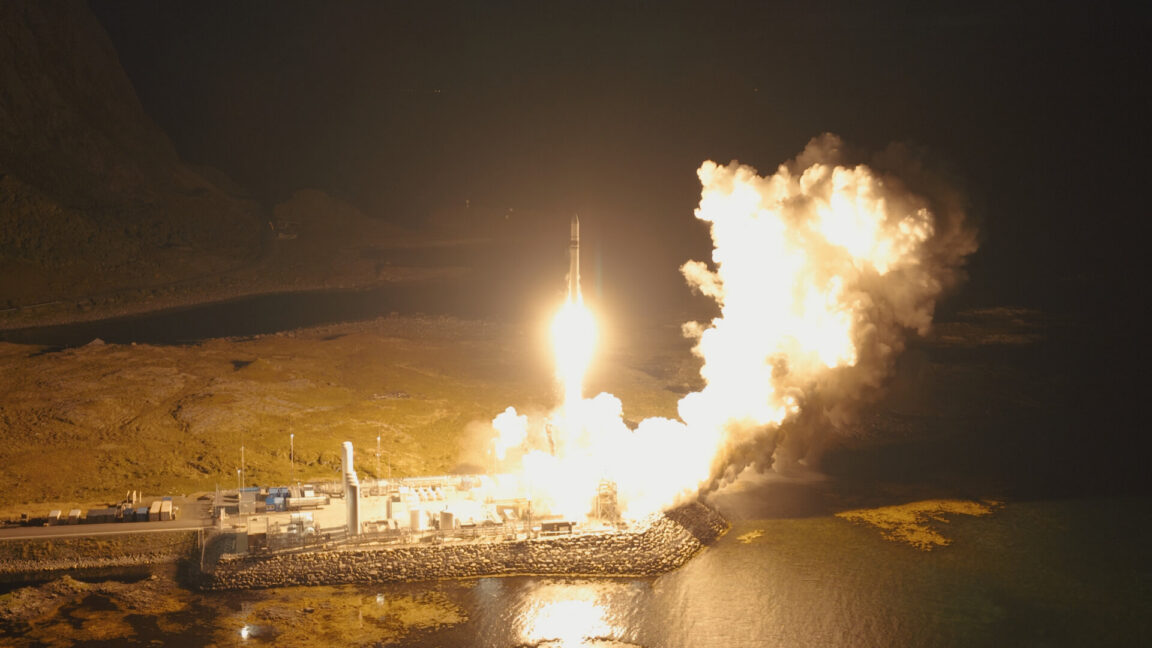
# German Company Breaks European Launch Monopoly with First Commercial Orbital Rocket
Rocket Factory Augsburg (RFA), a German aerospace startup, has achieved a historic milestone by launching Europe's first fully commercial orbital rocket without government subsidy or direct state involvement. The accomplishment breaks a decades-long European dependence on government-backed programs and represents a fundamental shift in how the continent approaches spaceflight.
The company compressed a development timeline that traditionally required decades of industry work into just a few years. RFA's achievement underscores how commercial space companies can move faster than legacy institutions burdened by government bureaucracy and bloated budgets. The quote from company leadership reflects genuine surprise at their own speed: "We achieved within a few years what had taken the European space industry decades before."
RFA developed the AriusXL, a small-to-medium lift rocket designed for commercial missions to low Earth orbit. The vehicle targets the growing constellation satellite market, where companies like SpaceX, Relativity Space, and others already compete. The European space sector, historically dominated by Arianespace and its government-funded Ariane family of rockets, has lagged behind commercial competitors in launch cadence and cost efficiency.
Until RFA's launch, Europe relied on Arianespace's Ariane 5 and the upcoming Ariane 6 for orbital access. Both programs involve substantial government funding through the European Space Agency and national budgets. Traditional European launchers cost significantly more per kilogram to orbit than SpaceX's Falcon 9 or emerging competitors. This cost disadvantage has pushed European companies to book flights on American or private rockets, draining capital from the continent's space industrial base.
RFA's bootstrapped approach differs fundamentally from this model. The company raised private capital, attracted talent from aerospace and tech sectors, and iterated rapidly on rocket design without waiting for government grants or ESA approval cycles. This mirrors the commercial space revolution that transformed the US market after SpaceX entered the industry.
The launch signals a potential inflection point for European spaceflight. If RFA succeeds in achieving reliable, frequent orbital flights, it could attract investment to other European commercial space ventures. German government support for the company remained minimal, focusing mainly on regulatory clearance rather than funding development. This contrasts sharply with how legacy European space programs operate.
Challenges remain substantial. RFA must demonstrate reliable reusability, achieve competitive pricing, and secure sustained customer demand. The company operates in an increasingly crowded small-launch market where multiple startups compete for limited constellation deployment contracts. Relativity Space, ABL Space Systems, and others pursue similar missions with different technological approaches.
Yet RFA's achievement matters beyond its immediate commercial prospects. It proves European entrepreneurs and engineers can build competitive orbital launch systems outside government frameworks. This capability may inspire additional startups, attract venture capital to European space ventures, and force legacy programs to modernize. The space industry recognizes that speed, cost control, and market focus drive success. RFA demonstrated these qualities faster than anyone expected.