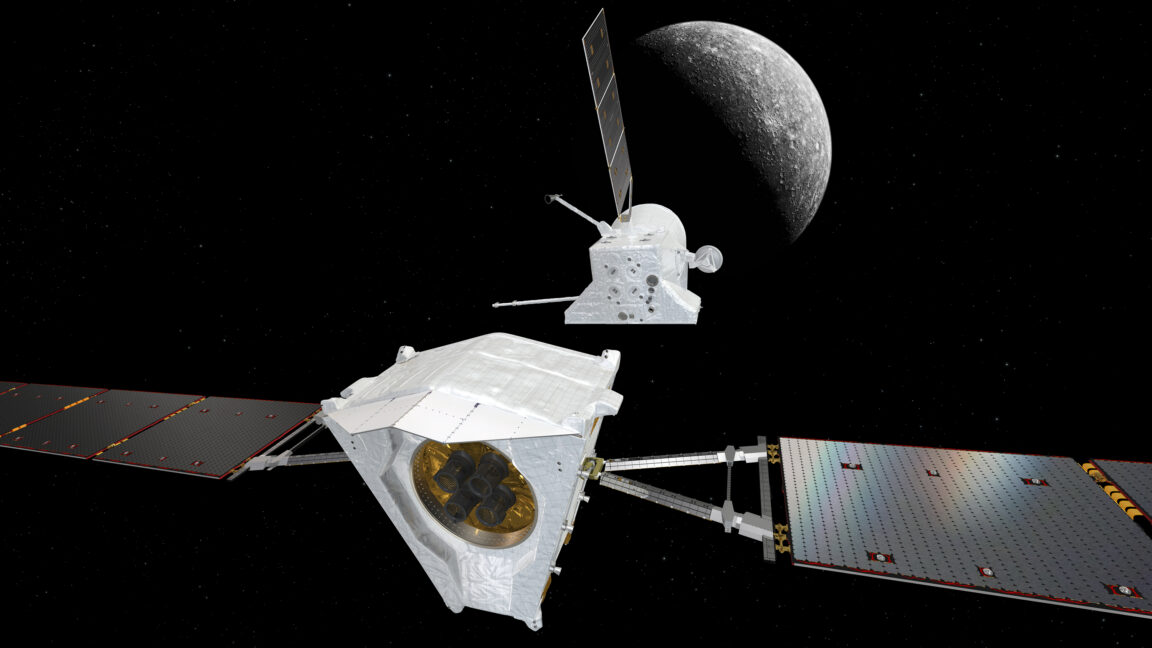
Europe's BepiColombo spacecraft is entering its final approach phase after eight years of spaceflight, marking the culmination of one of humanity's most ambitious planetary science missions. The joint European Space Agency and Japanese space agency JAXA probe is closing in on Mercury, the solar system's smallest terrestrial planet and one of its least understood worlds.
BepiColombo launched in October 2018 from French Guiana aboard an Ariane 5 rocket. The spacecraft has spent nearly a decade maneuvering through the inner solar system, relying on a series of gravity assists from Venus and Mercury itself to gradually reduce its velocity and enter orbit around the planet closest to the sun. This indirect route was necessary because traveling directly to Mercury would require enormous amounts of fuel, making the cost prohibitive.
The mission carries two separate orbiters designed to study Mercury from different perspectives. The Mercury Planetary Orbiter, built by JAXA, will examine the planet's structure, composition, and geology. The Mercury Magnetospheric Orbiter, developed by ESA, will investigate Mercury's unusual magnetic field, which is roughly one percent as strong as Earth's despite the planet's large iron core. This magnetosphere research represents an unprecedented opportunity to understand how magnetic fields form and function on worlds vastly different from our own.
Mercury presents a scientific puzzle that has long frustrated researchers. The planet orbits closer to the sun than any other, experiencing extreme temperature swings from 430 degrees Celsius on its day side to minus 180 degrees Celsius at night. It possesses a disproportionately large iron core relative to its size, raising questions about how such a composition came to exist. The BepiColombo team aims to answer fundamental questions about Mercury's origin and evolution.
"Fundamentally, we want to learn about the origins of this planet and how it came to be like it is," the mission's scientific leadership stated. This investigation extends beyond simple curiosity. Understanding Mercury's formation and development provides insights into planetary formation processes across the solar system and offers clues about how terrestrial planets develop under extreme solar radiation.
The spacecraft's instruments include high-resolution imaging cameras, spectrometers for analyzing surface composition, and magnetometers for mapping the magnetic field. These tools will operate simultaneously once the orbiters separate in Mercury orbit, allowing researchers to correlate observations and build a comprehensive picture of the planet's nature.
BepiColombo's arrival comes at a time when space agencies increasingly focus on inner solar system exploration. NASA's MESSENGER mission provided the first detailed maps of Mercury between 2011 and 2015, but BepiColombo promises substantially better resolution and additional scientific capabilities. The European-Japanese collaboration demonstrates how international partnerships extend space science capabilities beyond what single agencies could achieve alone.
The final approach phase will involve careful trajectory adjustments to ensure safe orbital insertion. Once in position, BepiColombo will conduct its primary science mission for one Earth year, with potential extensions if the spacecraft remains operational. The data returned will reshape our understanding of planetary formation, magnetic field generation, and the conditions that shape worlds in extreme environments near the sun.