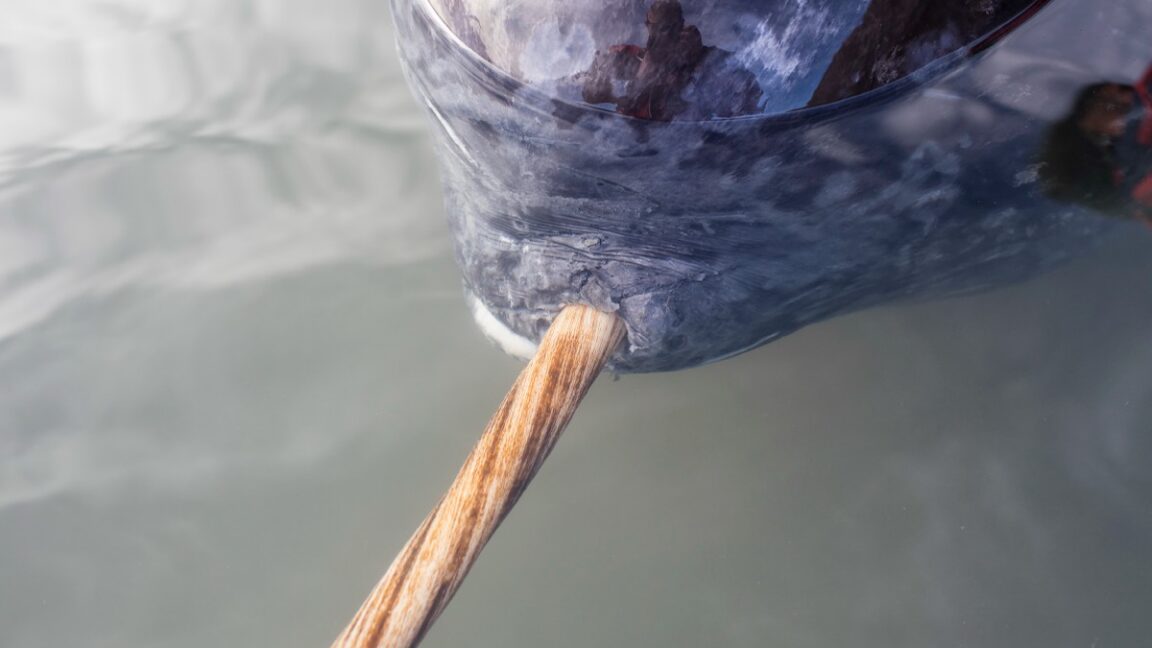
Researchers using X-ray imaging have discovered that narwhal tusks contain a previously unknown structural feature: two spirals twisting in opposite directions within a single tusk.
The study challenges the long-held assumption that narwhal tusks follow a simple helical pattern. High-resolution X-ray scanning revealed a more complex geometry. The outer layers spiral in one direction while inner layers spiral the opposite way. This dual-spiral architecture appears throughout the length of the tusk.
Narwhal tusks are elongated canine teeth that can reach up to 10 meters in length. Scientists have studied their composition and sensory capabilities for years. The tusks contain millions of exposed nerve endings, suggesting they function as sensory organs to detect changes in water temperature, salinity, and pressure. The new spiral discovery adds another layer to understanding tusk mechanics.
The opposing spirals likely distribute stress more evenly across the tusk structure. This design pattern appears in engineering applications where dual-helix configurations provide superior strength and flexibility compared to single spirals. The narwhal tusk achieves something similar through biological development.
The research involved detailed imaging of multiple tusks at different growth stages. The spiral pattern remains consistent across specimens, indicating this is not a random variation but a fundamental structural principle. Researchers also examined how the spiral geometry influences the tusk's response to bending and pressure.
Understanding narwhal tusk architecture has practical implications beyond marine biology. Engineers studying bio-inspired materials increasingly look to natural structures like narwhal tusks for design principles. The counter-rotating spiral pattern could inform development of stronger, more flexible materials for dental work, construction, or manufacturing.
The findings emerge as climate change threatens narwhal populations in Arctic regions. Studying their biology becomes increasingly urgent as their habitats shift. The tusk's complex sensory and structural capabilities reflect millions of years of evolutionary refinement in extreme