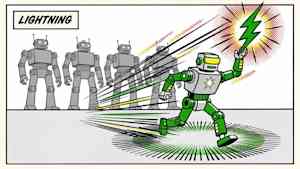
Nvidia released two tools Tuesday targeting the persistent cost problem enterprises face when deploying AI agents at scale. Nemotron 3.5 Lightning, a 30-billion-parameter mixture-of-experts model, and NeMo Switchyard, an open-source routing library, work together to cut inference costs to roughly one-third in Nvidia's testing.
The core problem is familiar. Running every task through a frontier model like GPT-4 balances quality with prohibitive bills. Building custom routing logic to send simple queries to cheaper models solves cost but creates a maintenance burden whenever workflows change. Nvidia's approach automates this decision-making.
Switchyard evaluates each step of an agent workflow and routes it to the most appropriate model. Simple tasks go to smaller, faster models. Complex reasoning goes to larger ones. Lightning, built as a mixture-of-experts architecture, excels at specialized, high-volume agent work. Nvidia claims Lightning delivers up to 4x faster output than comparable 30-billion-parameter models in its class.
The efficiency gains come from two angles. Lightning's sparse mixture-of-experts design activates only the model components needed for each query, reducing computation overhead. Switchyard's dynamic routing prevents overprovisioning by sending tasks to models matched to their difficulty.
The open-source release matters. Enterprises get full control over model behavior and routing decisions without vendor lock-in. They can audit the routing logic, modify it for proprietary workflows, and fine-tune Lightning on domain-specific data.
Real-world implications vary. For companies running thousands of daily agent tasks across customer service, content moderation, or data analysis, one-third cost reduction compounds quickly. For smaller deployments, the engineering overhead of implementing Switchyard might not justify the savings. The mixture-of-experts design also adds latency uncertainty since sparse activation times vary