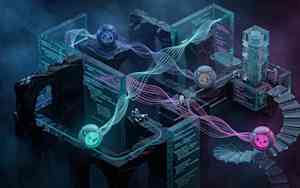
Researchers have developed AgentRadio, a system enabling multiple AI agents to coordinate in real time while solving complex enterprise coding tasks. The breakthrough addresses a fundamental limitation in multi-agent AI: most systems force agents to work sequentially or lose efficiency when trying to communicate.
AgentRadio uses an asynchronous message-passing layer that lets agents share information between execution steps without interrupting their primary work. This architecture proves essential for enterprise codebases where subtasks depend heavily on each other. The system allows agents to course-correct mid-task based on discoveries from their teammates.
In testing, four agents coordinating through AgentRadio outperformed Claude 3.5 Opus on enterprise coding assignments. The performance gain stems from the system's ability to handle long-horizon tasks that demand multiple tool interactions and real-time problem-solving adjustments.
Enterprise codebases present a specific challenge for AI agents. As repositories grow, single agents struggle to maintain context across all the code analysis and refactoring work required. Splitting tasks among multiple agents should logically improve performance, but prior multi-agent architectures forced rigid workflows. Agents either waited for each other in sequence, losing parallelization benefits, or worked independently without sharing critical findings.
AgentRadio changes this by letting agents communicate asynchronously. One agent discovering a dependency can immediately signal others without halting its own execution. This creates a genuinely collaborative system where agents build on each other's discoveries in real time.
Researchers from Coral AI Labs partnered with multiple universities to develop and test the framework. The results suggest multi-agent coordination represents a viable path forward as enterprises demand AI systems capable of handling increasingly complex codebases. Rather than scaling single powerful models, orchestrating specialized agents with effective communication channels delivers better results on real-world tasks.
The approach has broader implications beyond coding. Any domain requiring multiple AI agents to solve interdep