Stanford University researchers are operating 37,000 AI agents in parallel to simulate a virtual biotech company, demonstrating that the future of AI development lies not in single powerful agents but in massive coordinated swarms. One drug candidate designed by this system received independent validation from Merck, marking a concrete proof point for the approach.
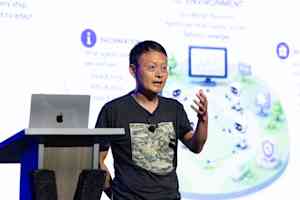
James Zou, associate professor of biomedical data science at Stanford, presented the research at VB Transform 2026, challenging the dominant model in AI development. While most teams currently assume one engineer pairs with one AI agent like Claude Code, Zou's work shows that tens of thousands of agents collaborating on specialized tasks can solve complex real-world problems that single agents cannot.
The system orchestrates these thousands of agents by connecting legacy databases to AI coordination layers. Agents work in parallel across different functional areas, mimicking how actual biotech companies operate: some agents handle drug screening, others work on molecular design, others manage data organization and research synthesis. This architectural approach transforms AI from a point tool into a distributed workforce.
The Merck validation carries significant weight. Independent confirmation from a major pharmaceutical company that Stanford's AI-designed drug candidate has merit suggests these multi-agent systems can produce scientifically sound results, not just plausible-sounding outputs. This moves the conversation from theoretical capability to practical application in regulated industries.
For developers and product builders, Zou's framework offers immediate practical value. His team has documented how to integrate existing databases, design agent communication protocols, and structure environments where thousands of agents can work simultaneously without interference. This blueprint addresses a critical gap: how to scale AI beyond single-instance deployments.
The implication extends beyond biotech. The same orchestration principles apply to finance, manufacturing, research, and any domain where multiple specialized tasks must coordinate toward a shared objective. The next generation of AI products likely won't compete on model scale but on how effectively they deploy