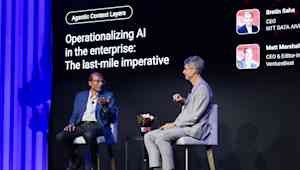
NTT DATA AIVista CEO Bratin Saha addressed a persistent bottleneck in enterprise AI adoption: converting frontier models into production-ready systems that actually deliver business value.
The core problem centers on what Saha calls "the last mile." Enterprises invest heavily in large language models and agentic AI, but struggle to operationalize them in regulated environments. A raw frontier model becomes usable only when wrapped in an organization's proprietary data, existing workflows, compliance requirements, and security controls.
This gap between model capability and enterprise deployment determines whether AI investments translate into measurable returns. The challenge goes beyond choosing the right model. It requires building governance layers, guardrails that prevent hallucinations or unauthorized actions, context injection that grounds models in company-specific information, and security measures that satisfy regulatory requirements.
For regulated industries, the stakes intensify. Financial services, healthcare, and government agencies cannot simply deploy a frontier model and hope for results. They need auditability, reproducibility, and the ability to explain decisions AI makes. An agent that approves a loan or recommends treatment must operate within defined boundaries and leave an audit trail.
NTT DATA AIVista positions itself as the bridge. Rather than competing with foundation model providers like OpenAI or Anthropic, the company focuses on the implementation layer. This means handling enterprise authentication, data governance, workflow integration, and policy enforcement. It handles the infrastructure work that transforms a statistical model into a reliable business tool.
The timing reflects market reality. Early AI adopters moved quickly to experiment with models. They've learned that experiments don't equal production systems. Now enterprises face the harder problem: scaling pilots while maintaining security, compliance, and reliability.
Saha's framing suggests the next wave of AI value creation won't come from better models alone. It will come from companies that solve the operational complexity surrounding those models. The last mile determines