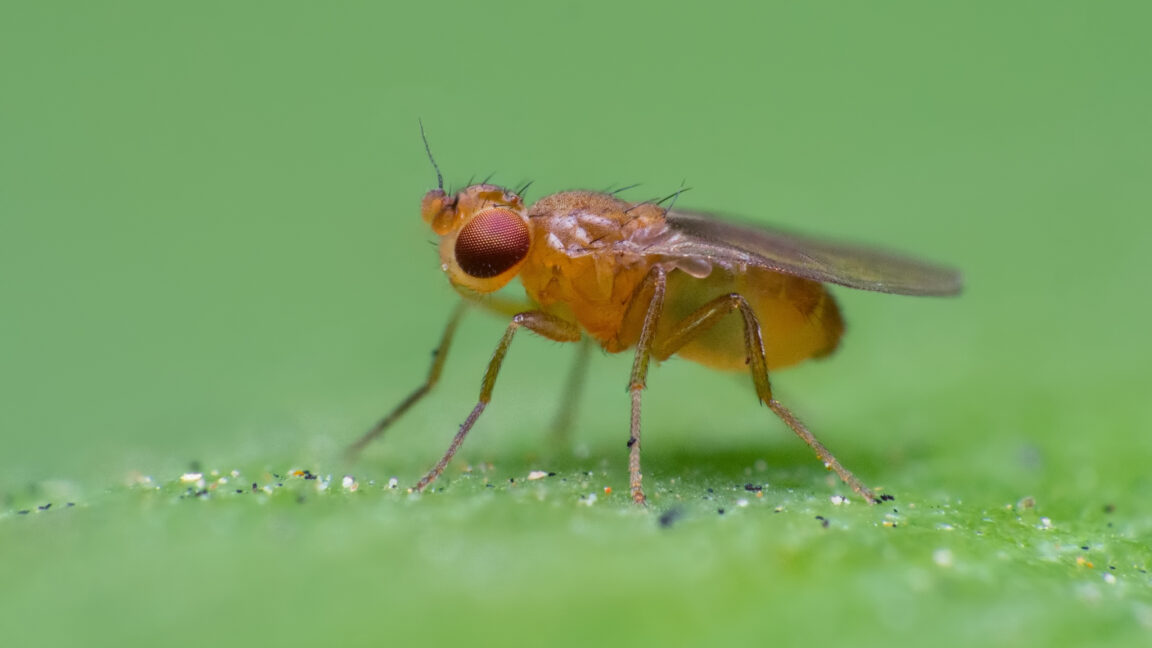
Fruit flies possess a sophisticated olfactory navigation system that allows them to track odor plumes through turbulent air with remarkable precision. New research reveals these insects rely on directional sensing and spatial memory to locate food sources despite chaotic airflow patterns that constantly disperse scent molecules.
When a fruit fly detects an odor, it doesn't simply follow a straight path to the source. Instead, the insect uses asymmetric antennal structures to sense which side of its body receives stronger scent signals. This directional information guides the fly upwind, toward the origin of the smell. The fly's brain integrates these signals with wind direction cues, allowing it to maintain a trajectory even when turbulence breaks the odor plume into fragmented patches.
Memory plays an equally critical role. Fruit flies remember recent odor concentrations and adjust their flight patterns accordingly. When they encounter a region with weakening scent, they employ casting behavior, sweeping their flight path side to side to reacquire the odor trail. This systematic search mirrors the behavior of mammals tracking scents on land.
The research has implications beyond understanding insect behavior. Engineers studying fruit fly navigation develop bioinspired algorithms for autonomous robots and drones operating in environments with air currents and chemical dispersal. A robot equipped with directional chemical sensors and memory-based decision logic could perform search and rescue operations, detect gas leaks, or map pollution sources more efficiently than current methods allow.
Fruit flies solve a computationally complex problem with a brain containing roughly 100,000 neurons, compared to the 86 billion in the human brain. This efficiency suggests evolution has optimized olfactory navigation to its simplest, most effective form. Understanding these mechanisms reveals how small nervous systems accomplish sophisticated sensorimotor tasks, offering a template for building compact, adaptive navigation systems in artificial systems where processing power and energy consumption