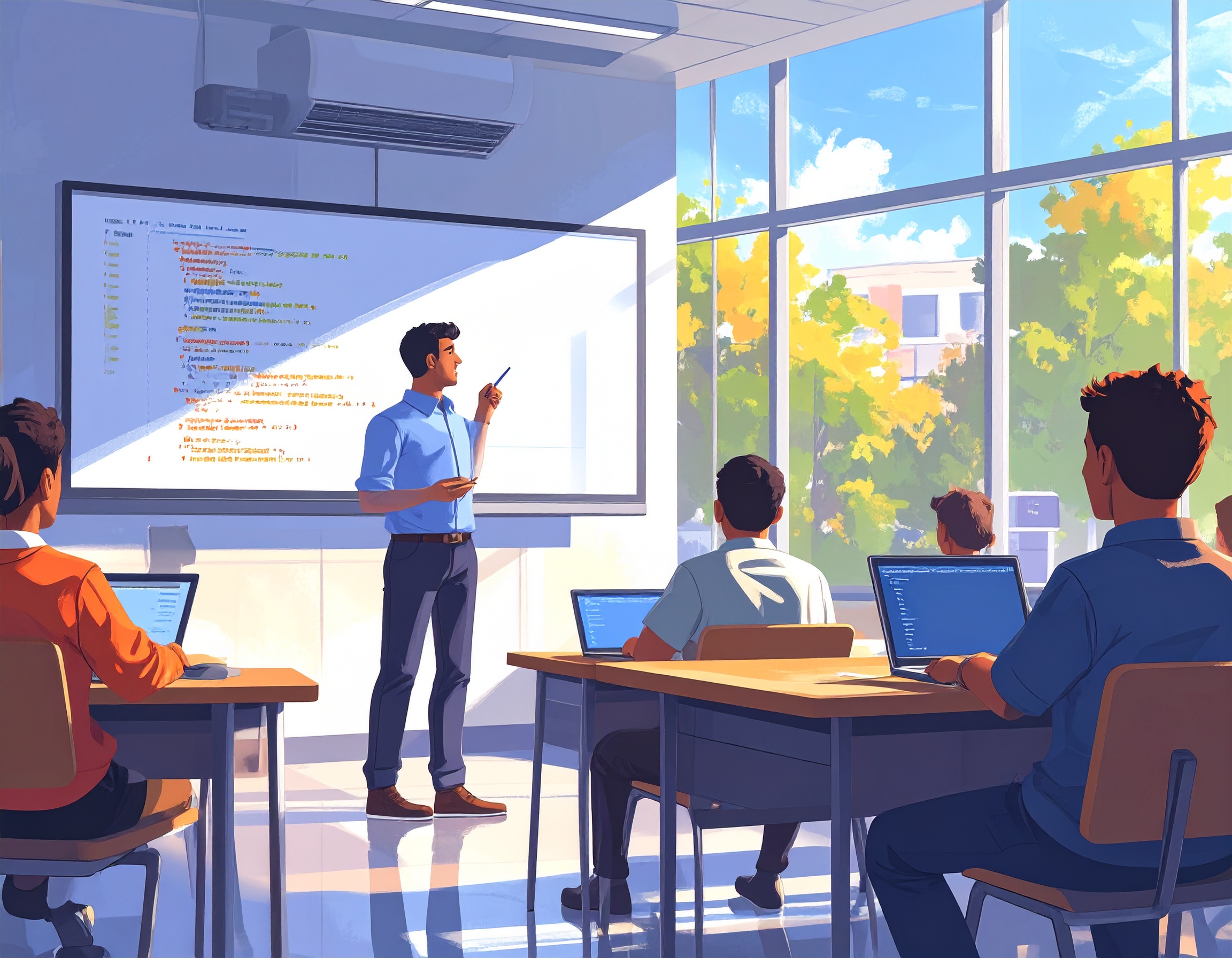
Computer science instructors face a fundamental challenge: AI coding assistants now write functional code faster than students can learn to write it themselves. The traditional assessment model, built on evaluating student code as a window into reasoning, breaks down when tools like GitHub Copilot and ChatGPT generate solutions instantly.
The problem runs deeper than plagiarism detection. Instructor feedback has always worked because code reveals where students struggle—syntax errors, logic flaws, inefficient approaches. That diagnostic value vanishes when AI produces clean, working solutions. Students copying code have always existed, but the ease and invisibility of AI assistance fundamentally changes the teaching equation.
Schools respond in different ways. Some shift assessment toward live coding interviews or pair programming sessions where students must explain their reasoning in real time. Others redesign curricula to emphasize debugging and code review rather than generation from scratch. A smaller group leans into AI as a learning tool, teaching students to use these systems effectively while focusing lessons on algorithmic thinking and architecture decisions that precede code writing.
The stakes matter because early programming education shapes how engineers think about problem decomposition, error handling, and testing. If students never struggle through basic syntax or wrestle with compiler errors, they miss the pattern recognition that translates to junior-level work.
Some educators argue this mirrors past disruptions. Calculators didn't kill mathematics. But that assumes schools adapted teaching accordingly. Many didn't. The parallel suggests institutions must move quickly to redesign coursework or risk graduating programmers who can invoke AI but don't understand what it does.
The hardest part isn't technical. It's changing what programming instruction measures. If code output no longer signals student understanding, what does. Live problem-solving. Architectural decisions. Test suite design. The pedagogical shift requires rethinking assessment from first principles, not just updating rubrics.