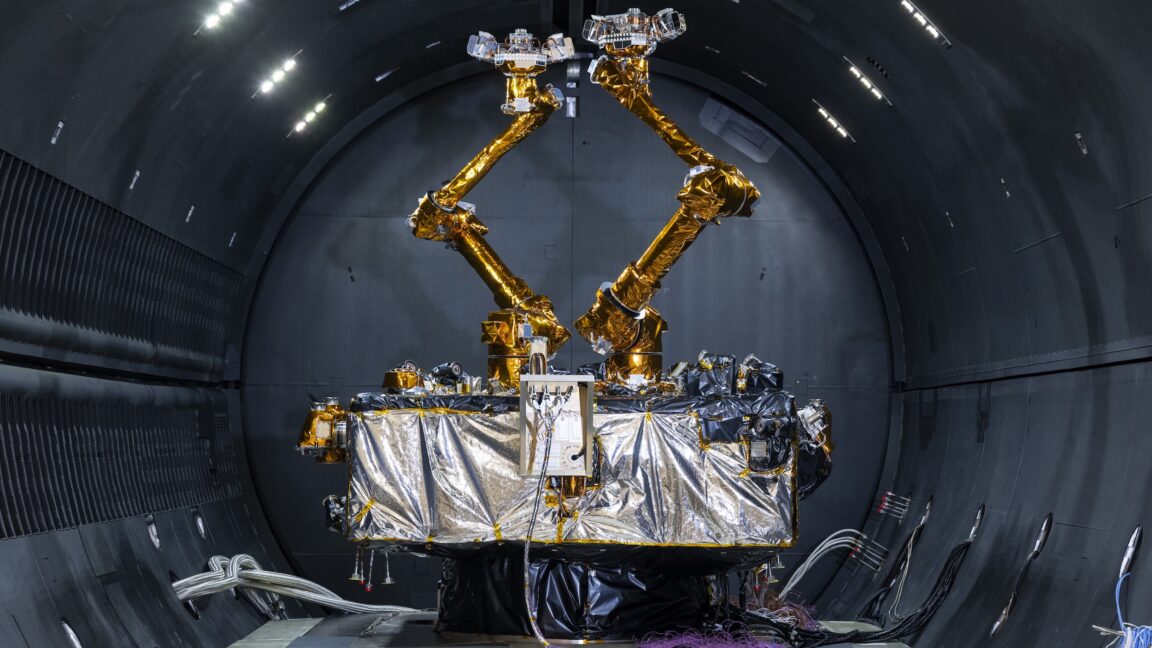
Northrop Grumman's Mission Extension Vehicle-2 (MEV-2) represents a leap forward in on-orbit satellite servicing, completing its first refueling operation in December 2023. The spacecraft successfully transferred propellant to Intelsat 901, a communications satellite launched in 1997, extending its operational life by years.
MEV-2 operates as an autonomous robotic servicing station. It approaches target satellites without human intervention, docks with them using specialized mechanical interfaces, and transfers fuel directly into their tanks. This capability addresses a critical problem in space operations. Most satellites lack fuel-transfer ports, forcing operators to abandon expensive hardware once propellant runs dry. Northrop's approach converts dead or dying satellites into functioning assets once more.
The system relies on precision robotics, autonomous navigation, and sophisticated docking mechanisms. MEV-2 can identify target satellites, maneuver into position, and execute delicate mechanical operations in the harsh vacuum of space. Each movement requires calculating trajectories, managing momentum, and compensating for orbital mechanics. The complexity is substantial. One software glitch or sensor miscalibration could render millions of dollars worth of equipment unusable.
The implications extend beyond single-satellite rescue operations. Successful servicing demonstrates that space infrastructure can be modular and repairable rather than disposable. Satellites now represent potential assets for multiple refueling missions rather than one-shot deployments. This shifts the economics of space operations, reducing launch frequency and lowering overall costs.
The phrase "things that tend to be really hard" understates the achievement. On-orbit refueling has been attempted for decades with limited success. Northrop's MEV-2 proves the technology works reliably at scale. The company plans additional servicing missions, and competitors including Axiom Space and others are developing similar capabilities.
The military implications remain