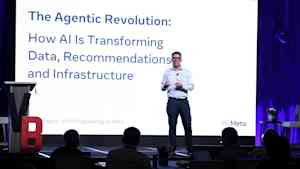
Meta's infrastructure VP warned that enterprises have roughly 20 months to rebuild their systems to handle autonomous AI agents, which are fundamentally reshaping how data systems operate.
Barak Yagour, VP of Engineering at Meta, told audiences at VB Transform 2026 that current infrastructure was designed for human users, not AI agents. The distinction matters because agents query systems differently, faster, and at unprecedented scale.
Meta experienced a 30x surge in agentic queries across its data infrastructure in a single half-year period. This explosion is breaking foundational assumptions the company spent two decades embedding into its systems. The growth pattern represents a fundamental inversion in how data flows through enterprise infrastructure.
The problem cuts deeper than mere traffic volume. Agentic AI operates with different access patterns, concurrency requirements, and latency tolerances than human users. Systems optimized for traditional web traffic, databases, and caching mechanisms fail under agent-driven demand. Queries arrive continuously without the natural pauses that characterize human interaction. Agents spawn multiple parallel queries, creating bottlenecks in architectures built for sequential human workflows.
Yagour's 20-month timeline reflects genuine urgency. Organizations waiting for gradual transitions risk infrastructure collapse as agent adoption accelerates. Meta itself invested heavily in reshaping its data systems, but the company had substantial resources and engineering talent. Most enterprises lack comparable capacity.
The challenge extends beyond infrastructure engineering. Teams must rethink authentication, authorization, rate limiting, caching strategies, and query optimization. Database schemas optimized for human-scale transactions perform poorly under agent workloads. Monitoring and observability tools built for human user behavior provide inadequate visibility into agent activity.
Early movers gain competitive advantage. Companies rebuilding infrastructure now establish foundations capable of scaling with agent deployment. Those delaying face potential crisis as agents multiply across their organizations.
Yagour's