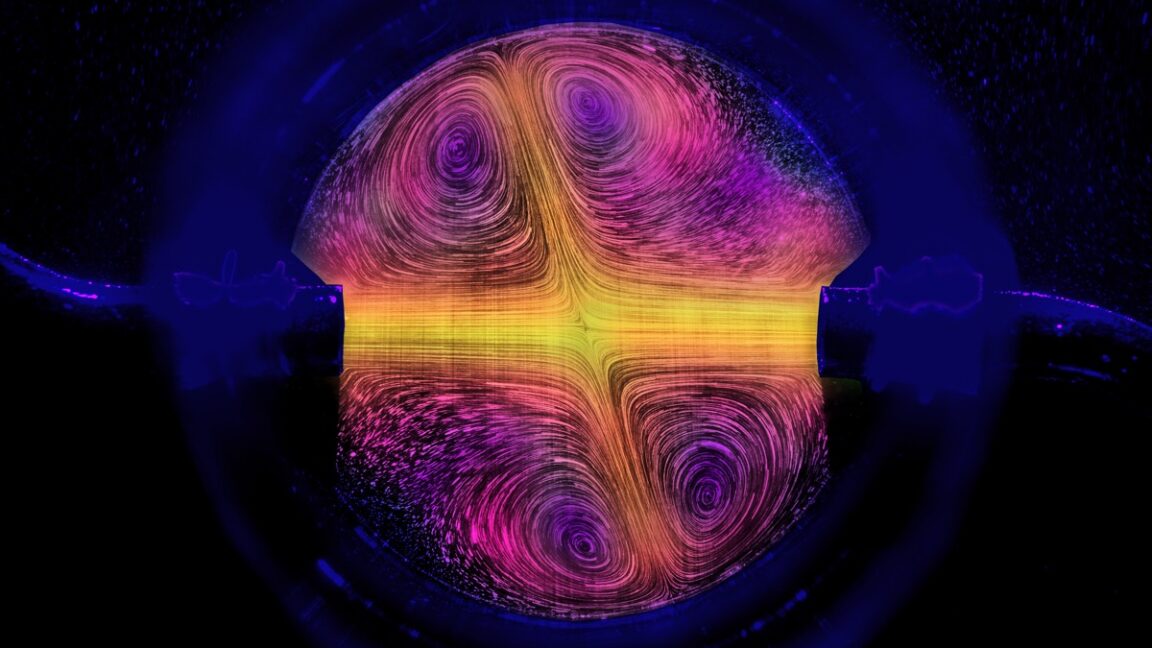
Researchers have resolved a decades-old physics puzzle about reverse sprinklers, with findings that extend to unconventional "silly sprinkler" designs as well.
The 2024 "momentum flux theory" explanation has now been experimentally validated. The theory shows that angular momentum carried by water flows, rather than reaction forces alone, drives the rotational behavior of sprinklers. This solves Feynman's reverse sprinkler problem, which stumped Richard Feynman himself and remained contested among physicists for years.
A reverse sprinkler operates counterintuitively. When water is sucked into a standard lawn sprinkler instead of ejected, the device rotates in the same direction as it would when spraying. Classical mechanics suggested it should spin backward, making the actual behavior paradoxical. The momentum flux theory explains this by accounting for the angular momentum of incoming water, which dominates over simple reaction forces.
The research validates that water's angular momentum flux, the rate at which spinning momentum enters or leaves the system, determines rotation direction and speed. This insight applies broadly to sprinkler designs, including "silly sprinklers" that deviate from traditional engineering principles.
Understanding these dynamics matters for fluid mechanics and rotational physics. The momentum flux framework provides clearer predictions across diverse water-flow systems than reaction-force-only models.
The confirmation comes through experimental testing that measured water flow behavior in various sprinkler configurations. Researchers tracked how water angular momentum correlates with observed rotation rates and directions.
This resolution demonstrates how seemingly abstract physics puzzles can drive practical understanding of real-world systems. The momentum flux theory now provides a unified framework for predicting sprinkler behavior across different designs and operating modes. The work clarifies fundamental principles of rotational dynamics that engineers and physicists can apply to turbine design, fluid machinery, and other applications involving rotating fluid systems.