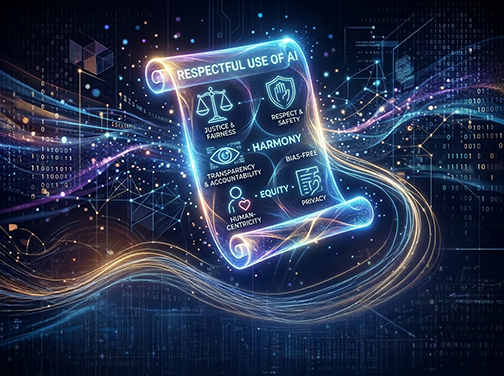
# Guidelines for Respectful Use of AI
Companies deploying AI tools focus heavily on security, compliance, and cost control. What they often miss is establishing norms for how employees should actually interact with these systems.
The gap reflects a broader pattern in enterprise AI adoption. Organizations build infrastructure and procurement strategies but skip the cultural groundwork. Without clear guidelines, teams develop inconsistent habits. Some employees treat AI as a replacement for human judgment. Others refuse to use it at all. Neither approach maximizes value or manages risk effectively.
Respectful AI use means treating the technology as a tool that augments human capability rather than eliminates it. It requires transparency about when AI influences decisions, especially in domains affecting people's lives. Finance, HR, healthcare, and customer service decisions powered by AI should be auditable and explainable to affected parties.
The O'Reilly piece, originally published on Medium, argues that leaders need explicit policies addressing several areas. First, employees should understand what data feeds into AI systems and what those systems actually do. Second, organizations should establish when human review is mandatory, not optional. Third, teams need permission to question AI outputs without penalty.
This matters because AI systems amplify existing biases and can make errors that humans might catch. A hiring algorithm trained on past data may perpetuate discrimination. A customer service chatbot can escalate frustration if it lacks genuine judgment. A financial model can miss context that undermines its recommendations.
Building respectful AI practices also protects companies legally. As regulation tightens around AI accountability, organizations with documented guidelines and human oversight demonstrate due diligence. They're better positioned if algorithmic decisions cause harm.
The practical solution involves training, documentation, and accountability structures. Teams need to know which decisions require human sign-off. They need feedback loops to report when AI fails. They need space to suggest improvements.
Respectful AI adoption recognizes that human