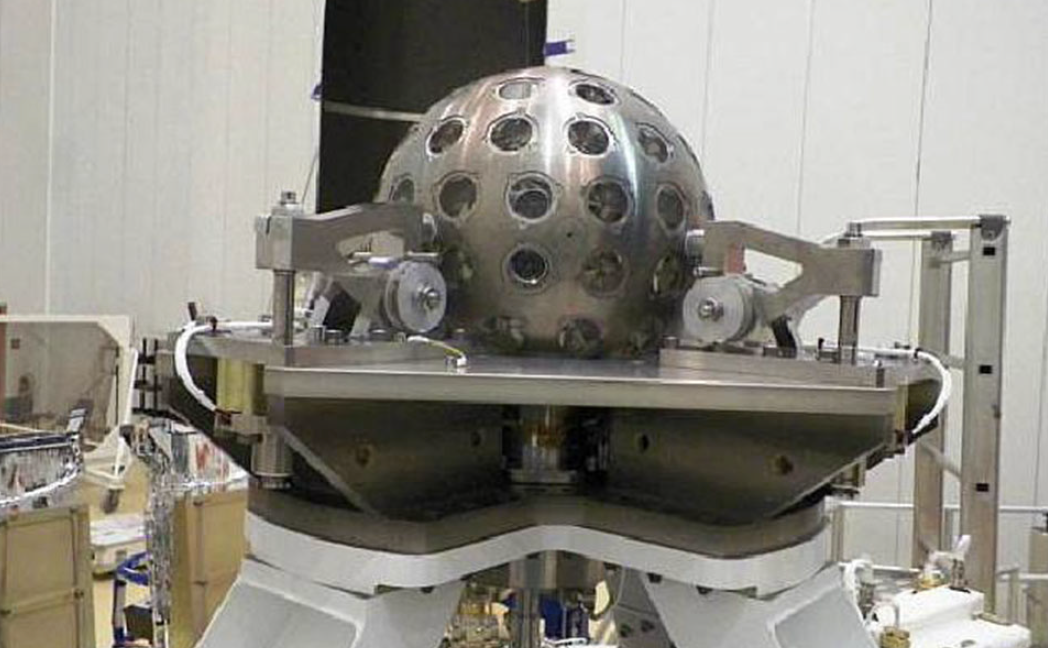
Scientists used an orbiting satellite equipped with a retroreflector array, nicknamed a "disco ball" for its reflective surface design, to conduct the most precise test of Einstein's general relativity theory to date. Researchers fired laser pulses from Earth at the satellite and measured the time it took for light to return, detecting minute delays caused by spacetime distortion around Earth.
General relativity predicts that massive objects warp the fabric of spacetime, slowing light's passage through curved regions. This effect, called the Shapiro delay, had been measured before using distant quasars and other cosmic objects, but those observations carried significant uncertainties. The retroreflector satellite provided unprecedented accuracy by offering a controlled, repeatable target with known orbital parameters.
The experiment leveraged laser ranging technology that can measure distances to millimeter precision. By tracking the satellite's position continuously over time, researchers collected enough data to detect spacetime curvature effects caused by Earth's gravity alone, without relying on more distant astronomical phenomena where measurements prove far messier.
The results confirmed Einstein's predictions to within extremely tight tolerances, leaving virtually no room for alternative gravity theories that might deviate slightly from general relativity at certain scales or conditions. The precision achieved represents a roughly tenfold improvement over previous ground-based measurements using other methods.
This work demonstrates how even relatively modest orbital infrastructure can test fundamental physics. The retroreflector satellites, originally deployed for other geodetic purposes, continue yielding scientific returns decades after launch. Future upgrades to laser ranging networks and deployment of improved retroreflector arrays promise even tighter constraints on general relativity alternatives.
The test matters because physicists remain uncertain how gravity behaves at quantum scales and within extreme environments like black hole interiors. While Einstein's theory works spectacularly well across cosmic and human scales, discovering deviations in specific regimes could point toward a deeper unified theory combining gravity