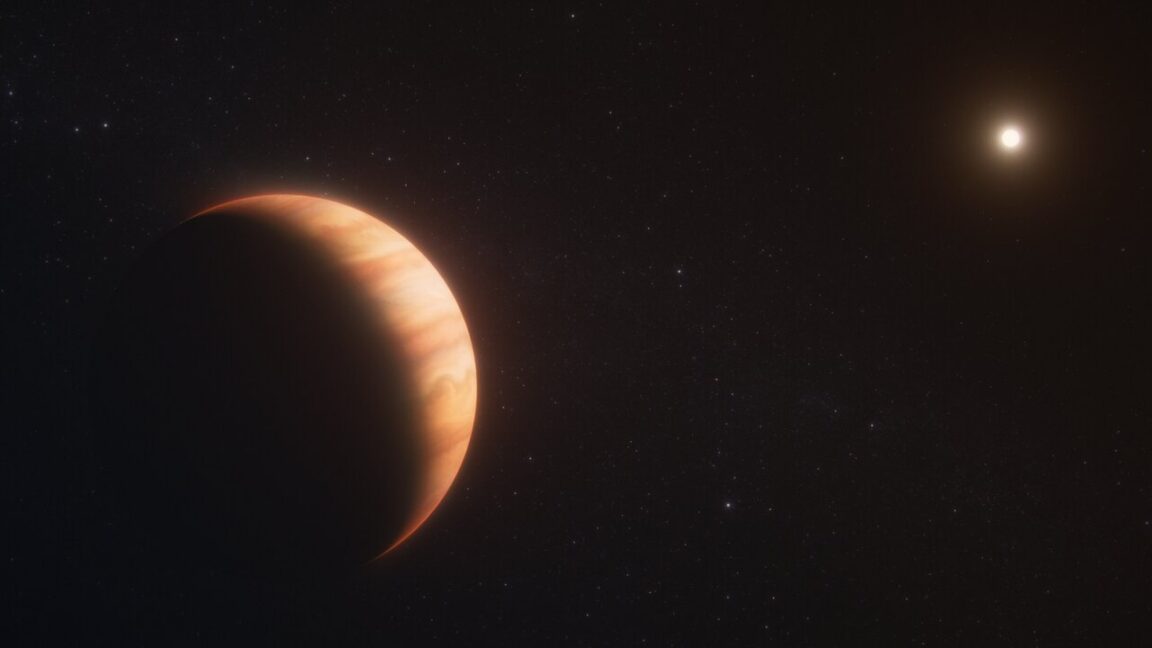
Astronomers have discovered a Jupiter-sized exoplanet orbiting a white dwarf star, a finding that challenges conventional understanding of planetary survival during stellar death.
The planet orbits its host star at a distance of roughly 0.6 astronomical units, closer than Mercury sits to our Sun. White dwarfs are the dense remnants left behind after stars like our own Sun exhaust their fuel and shed their outer layers. During this red giant phase, stars expand dramatically and typically engulf or destroy planets in their inner orbits.
This discovery raises a fundamental question: how did this Jupiter-mass world survive its star's death throes?
Researchers propose several mechanisms. The planet may have migrated outward before the star's expansion reached critical stages, allowing it to escape destruction. Alternatively, the current white dwarf may have captured the planet from interstellar space after becoming a white dwarf, though this scenario is considered less likely. A third possibility involves complex orbital dynamics where gravitational interactions with other bodies in the system nudged the planet into a wider orbit before the star's death.
The system was identified using data suggesting an excess of infrared radiation around the white dwarf, consistent with a debris disk orbiting the remnant star. Researchers then detected the planet's gravitational signature through detailed observations.
The finding has implications for understanding planetary system architecture and evolution. It suggests that Jupiter-sized planets can survive in hostile environments previously thought to be lethal. The discovery also broadens the search for habitable zones around white dwarfs, which some researchers have proposed as potential homes for life given their long lifespans and stable radiation output over trillions of years.
Understanding how planets navigate the death of their parent stars remains a critical gap in exoplanet science. This discovery provides concrete evidence that such survival occurs, even if the exact mechanism remains uncertain.