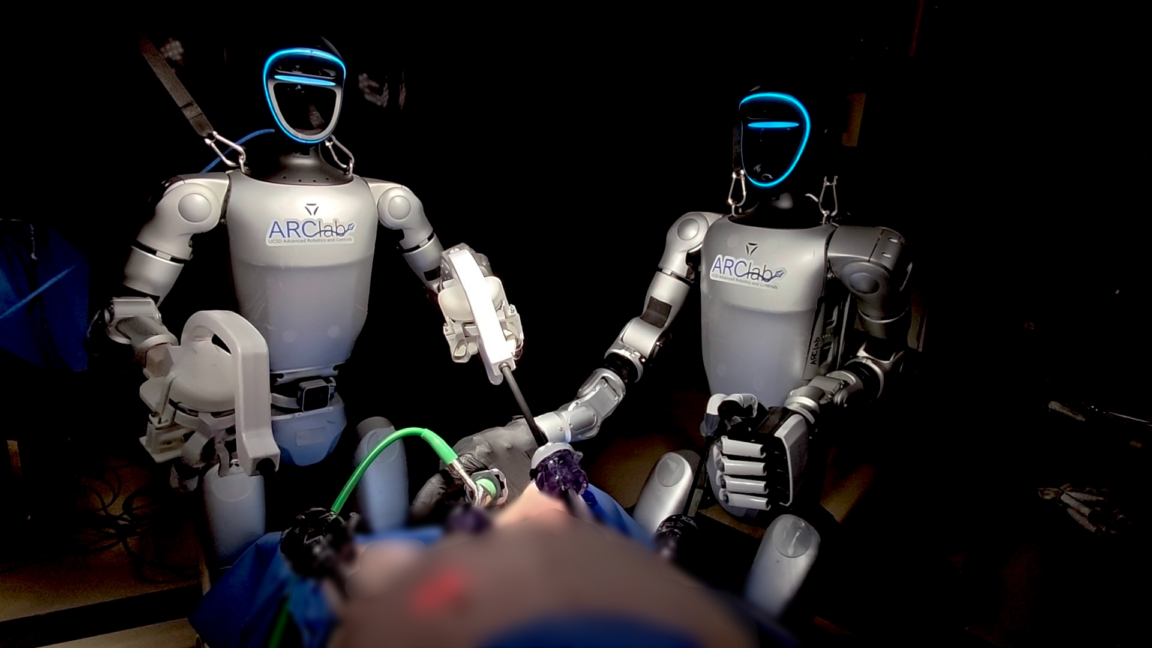
Surgeons operating humanoid robots remotely performed the first-ever surgical procedure on live pigs using this technology, marking a shift toward remote-controlled robotic surgery. The preclinical trial tested whether humanoid robots could feasibly handle complex surgical tasks under human direction.
The experiment involved surgeons controlling robot arms with precision instruments to perform surgical work on living tissue. This approach differs from traditional surgical robots like the da Vinci system, which surgeons operate from a console while seated nearby. Humanoid robots offer potential advantages in flexibility and reach, allowing surgeons to operate from remote locations without requiring specialized surgical suites redesigned around robotic equipment.
The trial's success suggests humanoid robots could eventually expand surgical capacity, particularly in underserved regions lacking access to specialized surgical expertise. Remote surgery eliminates geographic barriers and could enable top specialists to assist in emergency procedures across distances.
However, significant hurdles remain before clinical adoption. Latency, or delays in signal transmission, presents the largest technical challenge. Even millisecond delays can disrupt surgical precision. Network reliability and bandwidth requirements for real-time control demand substantial infrastructure improvements. Regulatory pathways for robotic surgery remain underdeveloped compared to traditional surgical robotics.
The trial also raises questions about surgeon training and liability. Surgeons must develop new muscle memory and spatial awareness when controlling humanoid robots rather than traditional instruments. Questions of responsibility emerge when technology mediates the surgeon-patient relationship.
The researchers frame this as proof-of-concept for future systems rather than immediate clinical deployment. Iterative improvements in robot dexterity, sensory feedback, and control latency will determine practical viability. Commercial adoption likely remains years away, pending regulatory approval and clinical validation in human patients.
The work positions humanoid robotics as a legitimate frontier in surgical innovation, moving beyond theoretical discussion into practical testing. Success here encourages further investment in remote surgical systems and potentially