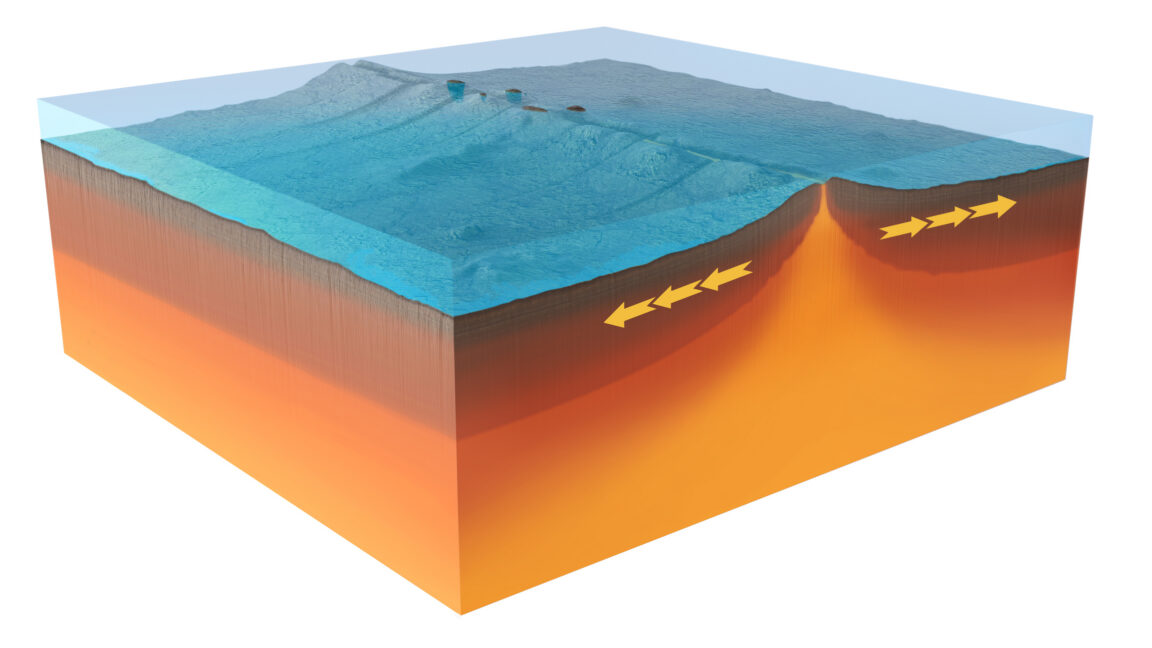
Scientists studying the East Pacific Rise discovered that seafloor spreading occurs in sudden, episodic bursts rather than as a continuous process. Researchers analyzed seismic data and bathymetric maps from a section of the mid-ocean rift zone off the coast of Mexico and found evidence of discrete spreading events concentrated over short time periods.
The findings challenge the long-held assumption that the Earth's oceanic crust expands gradually and steadily at rift zones. Instead, the data suggests that stress accumulates along the fault until it releases in violent episodes, similar to earthquakes. During these events, the two tectonic plates suddenly move apart, creating new seafloor material as magma wells up from the Earth's mantle.
The research team detected signs of multiple spreading episodes, each lasting days to weeks, separated by periods of relative quiescence. This episodic behavior explains some previously puzzling observations about mid-ocean ridge topography and the distribution of hydrothermal vents, which cluster near areas of active spreading.
Understanding seafloor spreading mechanics carries implications for geology and oceanography. The process directly influences global ocean circulation patterns, heat flow from Earth's interior, and the distribution of nutrients that support deep-sea ecosystems. It also affects our understanding of how plate tectonics reshapes the planet over geological timescales.
The episodic model opens new questions about the triggers for spreading events and the forces that govern their timing and magnitude. Future research using ocean-bottom seismometers and direct observation could provide real-time data on spreading events as they occur. This work represents a shift toward understanding mid-ocean ridges not as passive, steady-state features but as dynamic, seismically active zones where significant crustal deformation concentrates in brief, intense episodes.