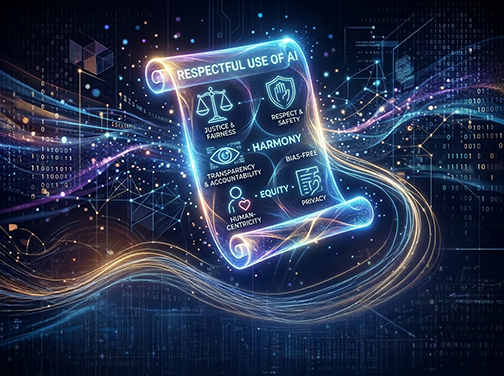
Companies rolling out AI tools across their organizations often focus on security, compliance, and cost controls. They're missing something equally important: how employees should actually use these systems in practice.
The gap exists because AI adoption discussions center on infrastructure and risk management rather than behavioral norms. Teams lack clear guidance on when to deploy AI, how to verify its outputs, and what human oversight remains non-negotiable. This creates inconsistent practices and exposes organizations to quality and liability problems.
Respectful AI use means treating the technology as a tool that augments human judgment, not replaces it. Employees need explicit policies covering several areas. First, which tasks warrant AI assistance and which don't. A marketing team might use AI for draft copy generation but shouldn't rely on it for client-facing financial analysis without verification. Second, verification protocols. AI outputs often sound confident while containing errors, so teams must know how to fact-check results before deployment. Third, transparency thresholds. Using AI to summarize internal documents differs fundamentally from using it to draft customer communications without disclosure.
Organizations should also address data sensitivity. Feeding proprietary information or customer data into public AI models creates security and privacy risks. Clear restrictions prevent leaks while still enabling productivity gains.
The framework requires leadership buy-in beyond procurement teams. Managers need to understand what their staff can and cannot do with AI tools. Training should cover not just capability but judgment. When does automation improve outcomes versus introduce unnecessary risk.
Companies that establish these norms early avoid chaos later. Teams work more effectively when they understand boundaries. Customers gain confidence knowing the humans behind their service remain accountable for AI-assisted decisions. And organizations reduce the liability exposure that comes from unchecked AI use in sensitive contexts.
Respectful AI use isn't about limiting technology. It's about embedding responsibility into how organizations adopt it.