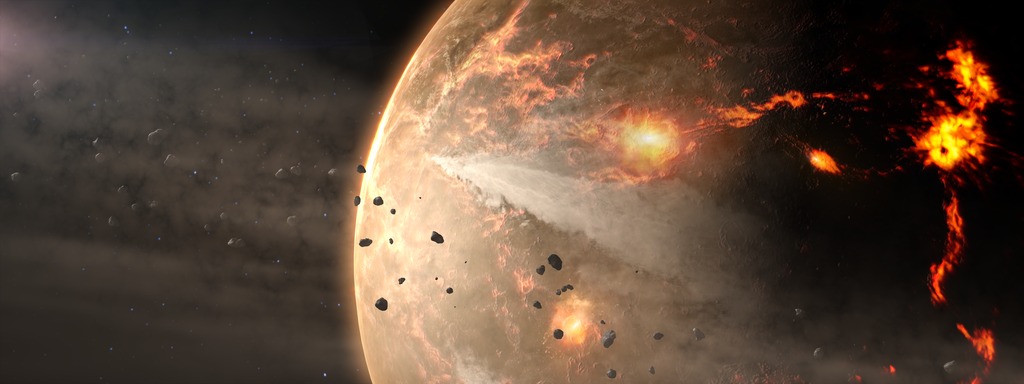
Early Earth's first solid crust likely melted and reformed multiple times due to cosmic bombardment, according to new research challenging the long-held assumption that only internal heat shaped the planet's primordial surface.
Scientists have focused primarily on radiogenic heating from decaying elements inside Earth to explain the extreme temperatures during the Hadean Eon, roughly 4.6 to 4 billion years ago. New evidence suggests that giant asteroid impacts delivered comparable or even greater thermal energy to the surface, fundamentally altering how the planet's crust developed.
The "missing 500 million" refers to a gap in Earth's geological record during the late Hadean when few rocks survived to preserve evidence of conditions. This period coincides with the Late Heavy Bombardment, when the solar system was still densely packed with asteroids and planetary bodies. Large impactors striking Earth transferred enormous kinetic energy, heating the crust to melting point and repeatedly resurfacing vast regions.
This mechanism explains why Earth's earliest crust appears fragmented and why scientists find evidence of multiple episodes of melting rather than a single cooling event. The thermal contribution from impacts likely prevented the crust from solidifying into a stable, permanent layer for hundreds of millions of years.
The research has implications for understanding planetary formation across the solar system and exoplanet systems. Bodies exposed to heavy bombardment in their early histories would experience dramatically different crustal evolution than previously modeled. The findings also bear on theories of early habitability, since a repeatedly molten surface would have prevented the emergence of life until the bombardment subsided.
Researchers used geochemical analysis and impact modeling to quantify the thermal effects of large asteroids hitting a young Earth. The work reconciles conflicting data about crustal composition and age while providing a more complete picture of our planet's violent youth. Understanding these early processes helps explain the transition from a hellish