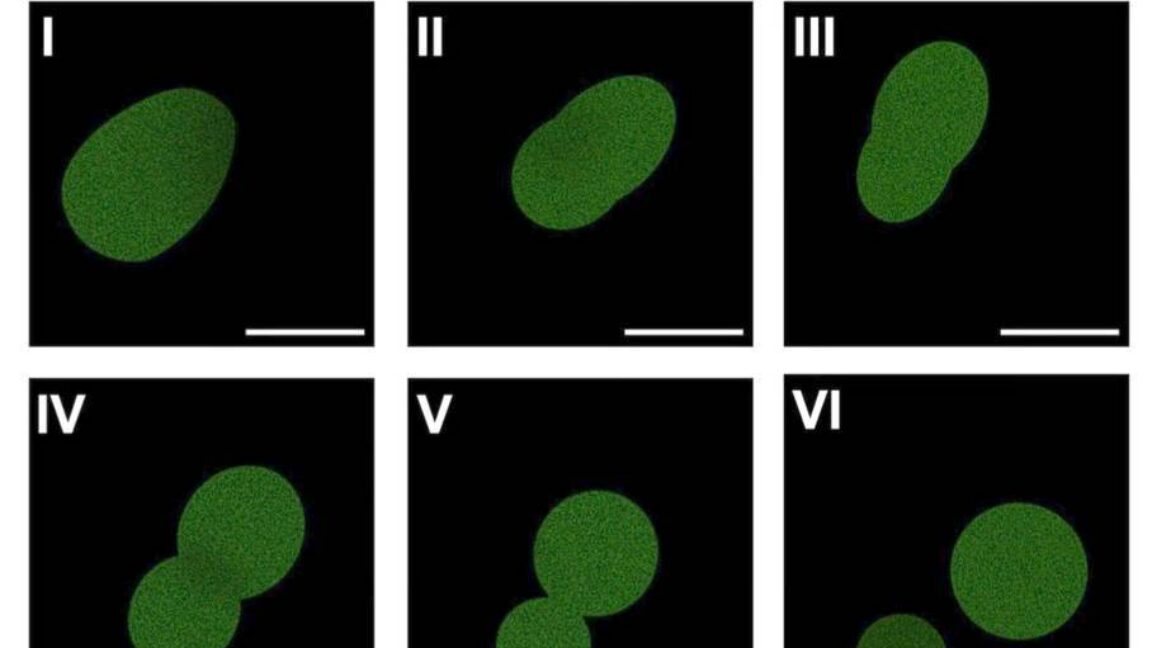
# Artificial Cell Completes Multiple Divisions Using Added Materials
Researchers have engineered an artificial cell capable of dividing multiple times, marking progress in synthetic biology. The cell achieves division cycles by relying on supplemented materials rather than self-sustaining biological processes.
The breakthrough centers on creating a minimal synthetic system that mimics core cellular functions. Traditional cells divide through complex coordination of DNA replication, protein synthesis, and membrane dynamics. The artificial system replicates this machinery in simplified form but requires external chemical inputs to function.
The limitation appears immediate. The artificial cell only completes a few division rounds before losing viability. Each division consumes the added materials faster than the system can regenerate them internally. Without continuous external replenishment, the cell cannot sustain further divisions or develop the biochemical complexity natural cells achieve through self-organization.
This constraint reveals the core challenge in synthetic biology. Building static structures differs vastly from creating self-perpetuating systems. Natural cells evolved intricate feedback loops, metabolic pathways, and error-correction mechanisms over billions of years. Reproducing even partial function requires engineering solutions that current science has only begun to address.
The research holds value despite its limitations. Each successful division demonstrates that synthetic systems can replicate key cellular behaviors. Understanding failure points informs future design. Researchers now know precisely where external support becomes necessary and which biological processes prove hardest to synthetically recreate.
Potential applications remain distant but real. Synthetic cells could eventually serve as programmable biological computers, drug factories, or biosensors. Getting them to function independently represents the real hurdle. The current work shows the path requires not just better engineering but deeper understanding of how life sustains itself across generations.
The few divisions achieved here represent early-stage validation. Scaling up to dozens or hundreds of divisions, let alone achieving true cellular autonomy, demands breakthroughs in synthetic metabolism and