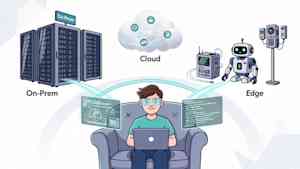
Couchbase launched its AI Data Plane, a platform designed to give AI agents immediate access to contextual data wherever they operate, from cloud servers to disconnected edge devices. The system combines three core components: persistent agent memory that survives across sessions, real-time context retrieval that fetches relevant information at decision moments, and an enterprise-managed Model Context Protocol (MCP) server for standardized agent integration.
The announcement reflects a fundamental shift in enterprise AI competition. Raw model capability matters less than architectural advantage. The real differentiator is which platform delivers the right data to an agent at the right time. Agents performing customer support, supply chain optimization, or field operations need instant access to historical decisions, customer profiles, inventory levels, and operational constraints.
Couchbase positions itself as uniquely qualified for this role. Unlike competitors who built agent infrastructure atop search or analytics platforms, Couchbase started in high-transaction caching and distributed databases. This foundation provides the low-latency writes and consistent data freshness that agent memory demands. When an AI agent processes a customer interaction, it needs to both retrieve past context and write new session state immediately, without the latency penalties that plague search-first architectures.
The critical technical advantage: identical operation across cloud, on-premises, and edge environments. Enterprise deployments rarely live in a single place. A manufacturing plant needs agents running locally on equipment with no cloud connectivity. A bank needs agents in its data center and in the cloud simultaneously. Couchbase claims its platform eliminates the traditional tradeoff between centralized intelligence and distributed execution.
The MCP server component standardizes how agents connect to data sources. Rather than custom integration work per deployment, enterprises get a managed protocol that scales across heterogeneous environments. This reduces implementation friction, which has historically plagued enterprise AI adoption.
The announcement targets enterprises already struggling with agent deployments in restricted environments.