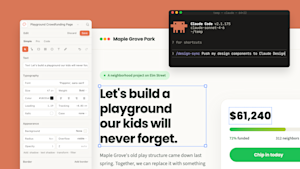
Anthropic has released a major update to Claude Design, its AI-powered design tool, addressing the token consumption problem that plagued its April launch. The overhaul introduces three core features: design system imports, code round-trips, and substantial efficiency improvements.
Claude Design attracted over one million users in its first week after launching as a research preview, but the tool's voracious token appetite became immediately apparent. A PCWorld reviewer exhausted 80 percent of their weekly Claude Pro token allowance in just 25 minutes while generating three webpage variations. The inefficiency made the product nearly unusable for serious design work.
The new version tackles this head-on with design system imports, allowing users to upload existing design systems and maintain consistency across projects without re-explaining design patterns to the model each time. Code round-trips enable designers to work bidirectionally between Claude's visual output and underlying code, eliminating the need to restart from scratch when iterating.
The efficiency improvements represent the most critical fix. By reducing unnecessary token consumption, Anthropic enables longer design sessions without burning through user allowances. The company didn't disclose exact efficiency gains, but the changes fundamentally alter the economics of using Claude Design for practical work.
The update reflects a broader challenge facing generative AI companies: balancing capability with resource consumption. When a free research tool becomes unexpectedly popular, token efficiency moves from a nice-to-have to a survival requirement. Users won't tolerate products that require minutes of interaction per week to remain functional.
Claude Design's initial momentum suggests real demand for AI-assisted design workflows. The token problem didn't kill interest, but it limited utility. These improvements position the tool for actual adoption in design workflows rather than novelty experiments. Whether the efficiency gains prove sufficient for production use remains to be seen, but Anthropic clearly recognizes that token cost directly impacts product viability.