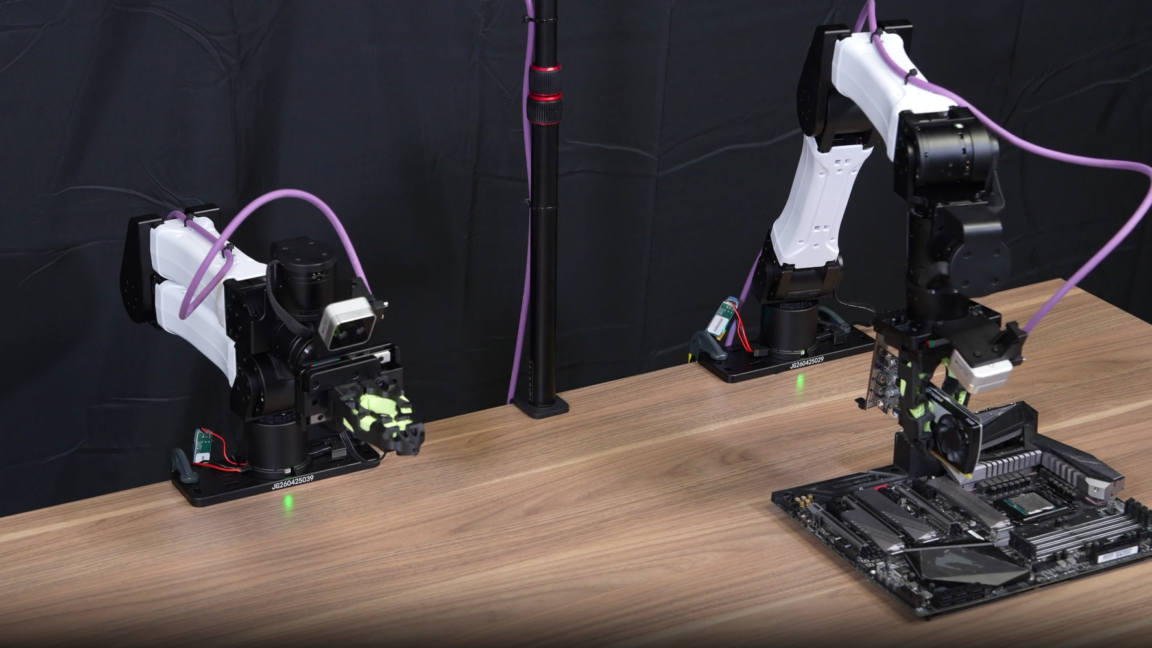
Nvidia has deployed teams of AI coding agents to teach robots physical tasks through a self-improvement framework. The program focuses on training robots to perform complex mechanical work, including GPU installation and cable management like cutting zip ties.
The approach leverages multiple AI agents working in coordination. Each agent contributes specialized coding capabilities to solve distinct steps of a robotic task. Rather than hard-coding instructions, the system enables robots to learn and refine their approach through repeated attempts and feedback loops.
GPU installation represents a particularly valuable test case. The task requires precise handling, alignment recognition, and force calibration. Zip tie cutting demands fine motor control and object manipulation. Both challenge robots to move beyond basic scripted motions into adaptive problem-solving.
Nvidia frames this as self-improvement because the agents generate code that improves robot performance over time. The AI doesn't simply execute pre-written instructions but generates new code sequences based on what works. This mirrors how humans debug and optimize code, but applied to physical robotics.
The use of multiple coding agents creates redundancy and specialization. One agent might handle vision processing while another manages gripper control. A third optimizes the sequence of operations. This distributed approach distributes complexity across focused subsystems rather than building one monolithic AI.
The implications extend beyond Nvidia's internal operations. Successfully automating GPU installation through AI-trained robots could reshape manufacturing and data center deployment. As AI models grow larger and demand more hardware, the bottleneck shifts from silicon production to physical installation and configuration.
This work sits at the intersection of three accelerating fields: large language models that can write code, computer vision systems that understand physical space, and robotics hardware that's becoming increasingly precise. Nvidia's effort suggests these pieces are converging into practical manufacturing applications.
The program represents an incremental but meaningful step toward factories where AI agents train robots for new tasks without human reprogramming. It remains narrow in