A new retrieval-augmented generation system bypasses text parsing entirely, improving accuracy while slashing token costs for AI agents by tenfold.
PixelRAG, developed by researchers at UC Berkeley, Princeton University, EPFL, and Databricks, challenges the standard enterprise RAG pipeline. Most systems convert web pages and documents to plain text before chunking and indexing. This conversion step destroys critical retrieval signals and causes the majority of retrieval failures, the team found.
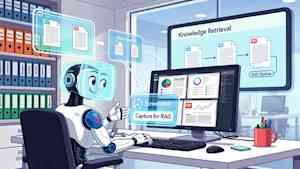
PixelRAG renders pages as screenshots instead. The system indexes these images directly and feeds retrieved visual tiles to a vision-language model for reading. Testing across 30 million screenshot tiles covering Wikipedia revealed substantial improvements over text-based approaches.
The core insight is simple but powerful: converting visual documents to text loses formatting, layout, and visual hierarchy that help humans locate relevant information. A screenshot preserves these signals, allowing the vision model to find answers faster and more accurately.
The token efficiency gains matter enormously for cost. By reducing tokens consumed per query by 10x, PixelRAG makes vision-based RAG economically viable for enterprise use. Fewer tokens mean faster responses and lower API bills, a critical factor for large-scale deployments.
Current limitations remain. The approach works best for documents with strong visual structure like web pages and PDFs with tables, charts, and formatting. Plain text documents gain less benefit. Vision models also process images slower than text, though this trades off against the retrieval efficiency gains.
The research undermines a core assumption in RAG design: that text extraction preserves all necessary information. Layout, typography, spatial relationships, and visual grouping carry semantic weight. Vision models trained on internet-scale data understand these cues naturally.
This opens new possibilities for document processing. Rather than fighting to extract perfect text from complex layouts, systems can work directly with visual representations. The approach