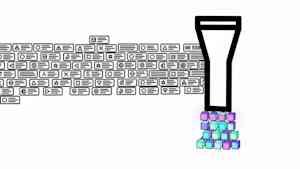
Context windows are becoming a computational bottleneck for large language models, especially as agents accumulate tokens from retrieved documents, reasoning traces, and conversation history. Researchers from NYU, Columbia, Princeton, University of Maryland, Harvard, and Lawrence Livermore National Laboratory released a new approach this week that achieves 16x context compression without accuracy loss.
The team proposes Latent Context Language Models (LCLMs), a new architecture that compresses context before it enters the model's main processing pipeline. Unlike existing solutions, LCLMs avoid the typical accuracy degradation that accompanies compression. The method also sidesteps a critical limitation of prior work: it doesn't require loading the full context before compression begins, making it practical for production systems with real-time constraints.
Current compression techniques struggle with a fundamental problem. They either trim information and lose accuracy, demand expensive upfront loading of complete contexts, or generate memory savings that don't translate into actual speedups on standard serving infrastructure like GPT or vLLM. Production systems have rigid memory and latency budgets. A technique that saves memory on paper but stalls actual inference won't deploy.
The LCLM approach uses an encoder to compress context into a compact latent representation, which the decoder then processes alongside the prompt. This architecture enables streaming compression. As new context arrives, the encoder processes it incrementally, feeding compressed tokens directly to the model without waiting for the full context window to load.
The 16x compression rate represents a substantial reduction in computational cost. For long-running agents managing multi-hop reasoning, customer support conversations, or document retrieval workflows, this translates into lower memory footprint, reduced latency, and cheaper inference. The paper demonstrates the method preserves model accuracy across multiple benchmarks, addressing the core tradeoff that has plagued compression research.
This work targets a real production constraint. As LLM-based