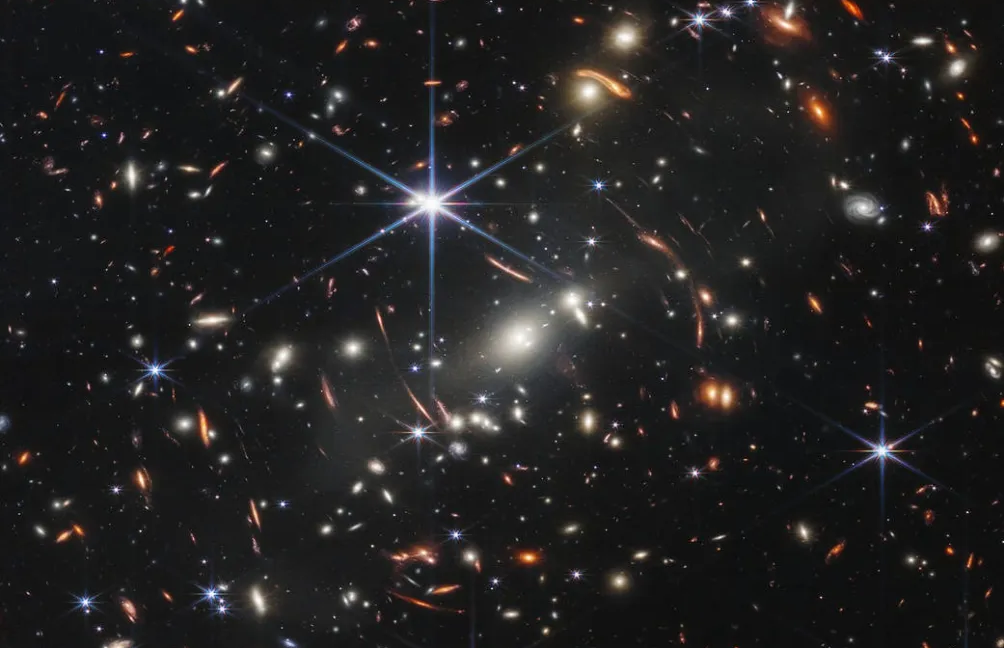
Astronomers have detected a galaxy existing just 800 million years after the Big Bang, making it one of the earliest galaxies ever observed. A gravitational lens, where massive objects bend light from distant sources, enabled researchers to study this ancient galaxy in unprecedented detail.
The discovery reveals that this early galaxy contains elements forged in the universe's first supernovae. Heavy elements like oxygen, neon, and magnesium appear in the galaxy's spectrum, evidence that at least one generation of massive stars had already lived and died by this point in cosmic history. This timeline compresses what scientists thought possible about the universe's chemical evolution.
Gravitational lensing acted as a cosmic magnifying glass, amplifying the faint light from this distant galaxy. Without this natural phenomenon, the galaxy would remain invisible to current telescopes. The technique relies on massive foreground objects, typically galaxy clusters, bending spacetime enough to magnify background light sources. This allowed researchers to collect sufficient photons to analyze the galaxy's composition.
The discovery challenges existing models of early star formation. If supernovae had already occurred 800 million years after the Big Bang, then the first stars must have formed even earlier than previously thought, and many must have been extremely massive. Massive stars burn through their fuel rapidly and explode as supernovae within tens of millions of years.
The findings carry implications for understanding reionization, the epoch when ultraviolet light from young stars and galaxies ionized neutral hydrogen throughout the universe. The timing and intensity of this cosmic transition depends on how quickly galaxies formed and produced massive stars. This early galaxy's composition suggests reionization occurred more rapidly than some models predict.
Future observations with advanced telescopes like the James Webb Space Telescope will likely uncover more such ancient galaxies. Each discovery refines our understanding of the universe's infancy and pushes back the timeline for complex chemistry in space.