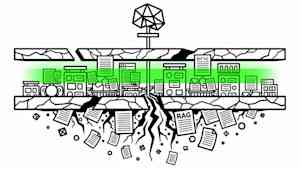
RAG systems are becoming obsolete as AI agents demand more sophisticated knowledge architecture. Vector databases alone cannot support the contextual reasoning agentic AI requires, forcing the industry to evolve.
Pinecone, the vector database pioneer, is leading this pivot with a new "compilation-stage knowledge layer" designed specifically for agentic workflows. The shift reflects a fundamental mismatch between legacy RAG pipelines and what modern AI agents need to operate effectively.
VentureBeat's Q1 2026 Pulse survey confirms this inflection point. Every standalone vector database is losing market share. Hybrid retrieval solutions have tripled their adoption intent to 33.3 percent, becoming the fastest-growing strategic position in enterprise deployments. This data reveals enterprises hitting a scale wall with simple RAG approaches.
The problem is straightforward. Traditional RAG systems retrieve documents and feed them to language models without building deeper contextual layers. Agentic AI operates differently. These systems must reason across multiple sources, maintain state, and execute multi-step tasks. They need compiled knowledge that's organized for agent reasoning, not just document similarity.
Pinecone's move signals the vector database category is transforming into something broader. Rather than pure similarity search, the next generation must handle knowledge compilation, context management, and agent-specific retrieval patterns. This isn't just a product tweak. It's architectural.
The timing matters. As enterprises deploy AI agents for complex workflows, they're discovering that RAG cannot scale beyond certain complexity thresholds. Hybrid retrieval combines multiple retrieval strategies, incorporating not just vector similarity but also dense passage retrieval, sparse lexical matching, and metadata filtering. This multi-modal approach better serves agent reasoning.
Pinecone's pivot positions it ahead of competitors still optimizing vector search. Other database vendors will face pressure to build similar compilation layers or risk becoming commodit